
In brief: The best extension ladder for you depends on how you plan to use it and the conditions at the job site. For light work in the yard or around the house, compact models with 8-10 rungs are often enough. For jobs higher up, such as cleaning gutters or working on exterior walls, you’ll need a longer ladder with 15 or more rungs. Our test explains which features matter most for safety and comfort.
Extension Ladder Test & Comparison 2026: A Buying Guide for Safe Work at Height
A good extension ladder is essential for many jobs around the house, in the yard or in the workshop. Whether you’re painting the exterior, trimming trees or cleaning the gutters, it gives you a secure way to work at height. With so many designs, materials and lengths to choose from, finding the right ladder can be a challenge. Our 2026 test and comparison helps you find the best ladder for your needs. We cover the key buying criteria and compare popular models side by side.
Contents
What types of extension ladders are available?
Not all extension ladders are the same. They’re generally grouped by their design and intended use. The basic straight ladder is the simplest type, with two side rails and rungs between them. It’s lightweight and easy to handle.
A versatile option is the multi-purpose ladder. It can often be used as a straight ladder, a step ladder or even a work platform. Its hinges and locking mechanisms make it more versatile, but also heavier and more complex to use.
Sectional or rope-operated ladders are especially useful for reaching greater heights. They consist of two or more sections that connect to one another, allowing you to reach heights that would be difficult to access with a single ladder. They’re ideal for professional use or very tall buildings.
Common uses
- Home & Yard: For painting, tree trimming and cleaning exterior walls.
- Trades & Industry: For assembly, maintenance and installation work.
- Emergency services: For quick, simple access to higher levels.
Which materials are commonly used for extension ladders?
A ladder’s material has a major effect on its weight, durability and intended use. The most common material today is aluminum. Aluminum ladders are lightweight, rust-resistant and sturdy, making them suitable for most jobs at home or on the job site.
Traditional wooden ladders are less common today. They’re heavier and need more care, but their surface doesn’t conduct electricity. They’re still often used where contact with electricity could pose a risk.
A modern alternative is a ladder made from fiberglass or glass-fiber-reinforced plastic (GFRP). These materials are electrically insulating, weather-resistant and highly durable. However, they often cost more and weigh more than aluminum models.
Special coatings such as CORDA material offer a middle ground. They have an aluminum core covered with a durable, grippy, corrosion-resistant layer. This can improve the ladder’s service life and comfort.
Tip: For general use around the house, an aluminum extension ladder is usually a great choice. It combines low weight, good stability and an affordable price. Check that the rungs are securely attached and that the ladder is well made.
Which safety features should I look for?
Safety comes first when working with ladders. A misstep or unstable footing can have serious consequences, so check for these important features when buying and using a ladder.
The load rating tells you the maximum total weight (person plus tools plus materials) the ladder is designed to support. Class I (130 kg) is suitable for DIY users, while commercial users should look for Class EN 131 (up to 150 kg).
Non-slip feet are essential. They provide a secure grip on smooth surfaces such as tile, concrete or wood. Good feet are made from soft, grippy material and have a wide contact area.
The rungs must be firmly secured to the side rails and provide a secure foothold. Ribbed or textured rungs offer good grip, even with wet or dirty footwear. Check that the ends of the rungs have no sharp edges.
For longer or particularly lightweight models, stabilizers or support bars are useful. They widen the ladder’s footprint and help prevent the feet from slipping sideways.
Warning: Never exceed the stated maximum load rating. Always set up the ladder at the correct angle of approximately 75 degrees. As a rule of thumb, the distance between the ladder feet and the wall should be approximately one quarter of the working height. Secure the top of the ladder to prevent it from tipping sideways.
How do I choose the right length?
Choosing the right length is essential for safety and comfort. A ladder that is too short can tempt you to overreach, while one that is too long is heavier and more awkward to handle. Ladder length is usually specified by the number of rungs.
A short 8-rung extension ladder such as the
is suitable for low-level jobs, with a climbing height of around 3.5 meters. It is ideal for painting garage doors, picking fruit, or tackling jobs on the ground floor of your home.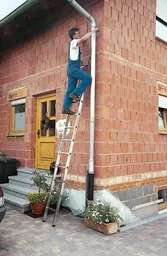
For a typical two-story home, a ladder with 10 to 12 rungs is a good all-around choice. It lets you reach gutters and second-floor windows comfortably and is also suitable for many gardening jobs.
Taller buildings and roof work call for longer models. A 15-rung extension ladder such as the
offers plenty of reach. For the greatest working height, sectional rope-operated ladders such as the are a good solution. Combining two sections gives you more reach than a single extension ladder can provide.
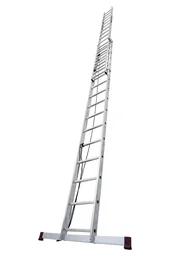
Note: When comparing ladder lengths, allow for the extra height needed beyond the landing point. To step safely onto a roof or reach a gutter, the ladder should extend at least one meter above the edge. Factor this extra length into your calculations.
Extension ladder length guide and uses
- 6-8 rungs: Low-level jobs, storage shelves, and small trees.
- 10-12 rungs: A good choice for most homes (siding, gutters, and windows).
- 14-16 rungs: Taller buildings, barns, and commercial use.
- 18+ rungs / sectional: Professional use and tall industrial buildings.
Which extension ladder is right for me?
The right choice depends on your needs. Our side-by-side comparison of current models will help you decide. The table below summarizes the key features of the extension ladders we reviewed.
Our top extension ladders compared:
| Model | Customer rating | Availability |
|---|---|---|
| Aluminum extension ladder with 10 rungs | – | Currently unavailable |
| Aluminum extension ladder with 15 rungs | – | Currently unavailable |
| Aluminum extension ladder with 8 rungs | – | Currently unavailable |
| Aluminum extension ladder with 18 rungs | – | Currently unavailable |
| Aluminum multipurpose ladder, 4 x 3 rungs | – | Currently unavailable |
For occasional DIY projects and easy storage, an 8-rung aluminum ladder is a solid choice. It is quick to set up and tall enough for most smaller tasks.
If you need a versatile ladder for typical jobs around the home, choose a model with 12 to 15 rungs. This length offers a good balance of reach and easy handling.
Professionals and homeowners with very tall buildings may need a sectional ladder or rope-operated ladder. Its main advantage is that you can combine two shorter, easier-to-transport sections to make one long ladder.
Remember to consider the right accessories too. A stable ladder stand, a tray for paint cans and tools, or a safety cage can make your work more comfortable and safer.
Care and maintenance for a longer service life
A good extension ladder is a long-term investment. With proper care, it will stay safe and ready to use for many years. Store it somewhere dry and sheltered, and do not leave it outdoors permanently. Rain, snow, and UV radiation can eventually affect aluminum and its coatings too.
After use, remove any loose dirt and moisture from the ladder. A soft brush or cloth is usually all you need. Avoid harsh cleaning products and abrasive sponges, which could damage the surface.
Carry out a regular visual inspection. Before each use, check the side rails for cracks or deformation. Make sure all rungs are secure and the feet are in good working order. On sectional ladders, check that the locking mechanisms work properly.
Transport your ladder carefully and protect it from impacts and sharp edges. A suitable transport strap or padding for your roof rack can help.
Checklist before each use
- Visual inspection: Check for cracks, broken rungs, or loose parts.
- Check the feet: Are the rubber caps intact and clean?
- Check the location: Is the ground level, firm, and clear of obstacles?
- Safe support point: Is the wall or other supporting surface stable enough?
- Correct angle: Use the rule of thumb to check the 75-degree angle.
With the right extension ladder and safe work practices, you can tackle jobs at height efficiently and safely. Our test and comparison can help you choose with confidence. Remember: even the safest ladder is no use if it is set up incorrectly or overloaded. Work carefully and look after your safety and the safety of anyone helping you.
Frequently asked questions
- What size extension ladder do I need?
- The right ladder length depends on the working height. Measure the maximum height you need to reach. Keep in mind that, at the recommended angle of around 75 degrees, you can climb to only about 3/4 of the ladder’s length. To work at head height on a 4-metre-high wall, you’ll need a ladder with at least 12 rungs.
- Are aluminium ladders safe?
- Yes, modern aluminium extension ladders are safe when used correctly. They’re corrosion-resistant, lightweight and sturdy. Look for quality features such as reinforced rung connections, non-slip feet and a tested load rating. Keep away from power lines, as aluminium conducts electricity.
- What are the benefits of CORDA ladders?
- CORDA extension ladders combine the lightness of aluminium with a special, durable coating. This protects the ladder from the effects of the weather and helps it last longer. The material also often provides a better grip and feels less cold to the touch than bare aluminium, which is especially useful in cold weather.
- Can I use an extension ladder as a stepladder?
- No, a standard extension ladder isn’t designed to stand on its own. It always needs to rest against a stable wall or another support at the correct angle. For work without a support surface, use a combination ladder or a proper stepladder with a stable base.
- How should I transport and store my extension ladder?
- Secure the ladder on a roof rack or inside your vehicle to prevent damage during transport. Store it in a dry place away from direct sunlight, ideally hanging it horizontally or laying it flat to prevent permanent deformation. Check the rungs and joints for damage before each use.