
In brief: The best fastener depends on the material and the load it needs to support. Fine-wire staples are a good choice for light indoor projects, while sturdy angle brackets work better for heavy-duty assemblies. Check the wire gauge, staple length and corrosion resistance. This buying guide can help you find the right fastener for your project.
Planning a project and wondering which fasteners to use? Whether you’re mounting shelves, joining wood or securing lightweight panels, there are plenty of staples, brackets and connectors to choose from. Our 2026 comparison covers the most common options and what to look for when shopping. Choose the right fastener for a strong, lasting connection.
Table of contents
What types of fasteners are available?
Fasteners fall into two main groups. The first includes nails, staples and pins, which are driven directly into the material and held in place mainly by friction and deformation. The second includes mechanical connectors such as brackets, plates and wall plugs. These distribute the load and create a secure, interlocking connection.
Staples and angle brackets are especially useful for DIY projects. Staples are quick to use and ideal for lighter assembly work. Angle brackets add stability to furniture and shelving. Find the right solution for your project in our wide range of fasteners.
How do staples differ?
Staples come in many types. The main differences are their wire shape, length, gauge and material.
Wire shape: fine wire vs. flat wire
Fine-wire staples have a round cross-section. They pass easily into materials and are less likely to split wood, making them a versatile choice for most woodworking projects. One example is the
with a length of 10 mm.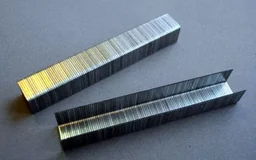
Flat-wire staples are wider and flatter. Their larger contact area helps prevent pull-out, especially when force is applied sideways. They work well with hardwood and for attaching wire mesh. The
is a sturdy example.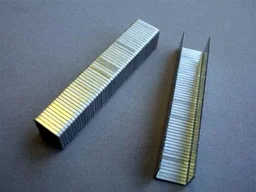
Staple length and gauge
Staple length determines how deeply a staple penetrates the material. 6 mm is enough for thin veneers, while thick beams may need 14 mm or more. Gauge refers to wire thickness and affects holding power. A gauge of 0.7 mm is standard, while 1.2 mm offers added strength.
Tip: For a deep, secure connection, choose a staple at least three times as long as the thickness of the material you’re fastening. This helps ensure a firm hold.
Here are some of the top-rated fasteners in our range:
| Model | Customer rating | Availability |
|---|---|---|
| 10 mm fine-wire staples, 1,000 pieces, 0.7 mm 🏆 Top pick | ★ 4,9 (15) | In stock |
| 14 mm fine-wire staples, 1,000 pieces, 0.7 mm | ★ 4,9 (13) | In stock |
| Angle bracket with embossed rib, 70 x 70 x 55 mm, 25 pieces | ★ 4,9 (9) | In stock |
| 8 mm fine-wire staples, 1000 pieces, 0.7 mm gauge | ★ 4,9 (7) | In stock |
| 6 mm fine-wire staples, 1,000 pieces, 0.7 mm gauge | ★ 5,0 (5) | In stock |
What should I look for in angle brackets?
Angle brackets are essential for sturdy furniture and shelving. Look for these features when choosing a high-quality bracket.
First, check the material thickness. A bracket made from thin sheet metal can bend under load. Pre-drilled holes make it easier to position and fasten the bracket accurately. An embossed rib—a pressed ridge that reinforces the metal—adds rigidity without much extra weight.
The
is a sturdy connector. Measuring 70 x 70 x 55 mm and featuring an embossed rib, it’s a good fit for medium-duty furniture projects.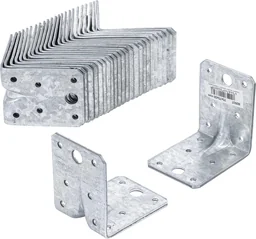
Warning: Don’t assume an angle bracket can support any load. Stability also depends on the screws and the quality of the wood. Test the assembly carefully before placing heavy items on it.
Which fastener should you use for each material?
The materials you’re joining are key to choosing the right fastener. The wrong choice can result in loose joints or damage to the material.
Softwood and particleboard
Fine-wire staples work well with softwoods such as spruce and pine, as well as particleboard. They penetrate easily and are less likely to split the material. Choose a medium length of 8-12 mm. Angle brackets are a good choice for corner joints in particleboard furniture.
Hardwood and composite materials
For hardwoods such as oak or beech and for MDF, flat-wire staples are often the better choice. They hold well in denser materials. Special hardwood nails or screws may also work. For permanent joints in hardwood, always pre-drill.
Thin materials and decorative projects
When fastening fabric, thin veneer or cardboard, use short, thin staples. The
with a length of just 6 mm is ideal for these jobs. It helps keep the staples from poking through the visible side.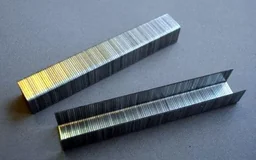
Note: Make sure the staples are compatible with your tool. Check your staple gun’s manual before buying, as not every staple fits every tool.
How to choose the right fastener
Follow a systematic approach to find the right product. Start by asking yourself these three questions.
- What are you fastening? Identify the material, its thickness and the load it needs to support.
- What tool do you have? Is it a manual staple gun, an electric staple gun or perhaps a screwdriver? Your tools will help narrow down your options.
- Where will the joint be used? Indoors or outdoors? In plain sight or out of view? These details affect your choice of material, including whether you need a rust-resistant fastener.
Your answers will help you narrow down the wide range of options. Browse our Tools category for more ideas and suitable tools.
Our guide to choosing fasteners
Here are the most important things to consider when buying. Use these tips to choose the right products.
Choose quality: Cheap staples made from soft steel can bend or break. Invest in sharp, precisely made staples to save time and frustration.
Choose the right size: Don’t stock up on staples in just one standard size. Keep two or three common sizes on hand for different projects, and you’ll be ready for most jobs.
Store them properly: Keep staples in a dry, dust-free place. Moisture can cause rust, damaging both the staples and your staple gun.
Buy what your project needs: Think about how you’ll use the fasteners before you buy. Choose products for the project at hand to avoid filling your toolbox with items you won’t use.
The right fasteners can make the difference between a wobbly structure and one that lasts for years. Use the advice from our 2026 review and comparison to choose with confidence and tackle your next project.
Frequently asked questions
- When should I use fine-wire staples, and when should I use flat-wire staples?
- Fine-wire staples have a round cross-section and work well with soft materials such as wood. They penetrate deeply and are less likely to split the material. Flat-wire staples have a larger contact area, making them a better choice for harder materials or applications where the fastener will be under tension. Choose based on the material you’re fastening.
- How important is staple wire thickness?
- Wire thickness affects a staple’s strength and holding power. Thicker wire (e.g. 1,2 mm) can handle heavier loads but requires a more powerful staple gun. For delicate work or thin materials, thinner wire (e.g. 0,7 mm) is often a better choice to help prevent damage.
- Can I use staples outdoors?
- Standard steel staples can rust quickly outdoors. For permanent outdoor fastening, use specially coated or galvanized staples to help protect them from the elements. Check the product description for weather-resistance information.
- What should I look for when choosing angle brackets?
- Check the dimensions, material thickness and number of pre-drilled holes. A stamped reinforcing rib can significantly increase stability. Choose a size that fits the parts you’re joining. Thick steel connectors are essential for heavy loads.
- Will any staples fit my staple gun?
- No. Staple guns are usually designed for a specific staple length and wire thickness. Use only staples recommended by the manufacturer. The wrong size can cause loading problems, poor fastening or even damage your tool.
You might also be interested in
- Technology Review & Comparison 2026: The best products in practical testing
- Power Tools Review & Comparison 2026: The best tools put to the test
- Security Systems Review & Comparison 2026
- Wall Anchors Review & Comparison 2026: The best fasteners put to the test
- Building Components Review & Comparison 2026
- Construction Adhesive Review & Comparison 2026: The best products at a glance