
In brief: Avoid the 5 most common cutting mistakes: working with a dull chain, incorrect chain tension, insufficient lubrication, an unsafe stance and ignoring the kickback zone. Regular maintenance, the right technique and sharp chains are essential for safe and efficient chainsaw work.
Table of contents
- Mistake 1: Poor maintenance and a dull chain
- Mistake 2: Incorrect chain tension
- Mistake 3: Insufficient lubrication
- Mistake 4: Incorrect body position and an unsafe starting method
- Mistake 5: Ignoring the kickback zone
A chainsaw is a powerful tool. It turns strenuous wood-cutting jobs into a quick task. But this power requires knowledge and respect. Many accidents and poor results are caused by recurring, easily avoidable mistakes. We show you the five most common mistakes and how to avoid them in future so you can work more safely and efficiently.
The basis for every clean and safe cut is a high-quality, sharp saw chain. It is the part of the tool that does the actual work. A robust and durable chain such as the Forstmeister chainsaw chain "Titan" () delivers optimum cutting performance and is more forgiving of minor mistakes. Invest in quality when choosing a chain to avoid frustration and dangerous situations.

How can I tell if a chainsaw chain is dull?
Working with a dull chain is the most common and also the most dangerous mistake. You force the saw through the wood instead of letting it cut. This not only increases the effort required and wear, but also significantly raises the risk of accidents. Look out for clear signs.
A sharp chain produces coarse, angular wood chips. It pulls itself into the wood almost by itself. A dull chain, on the other hand, produces fine sawdust, almost like flour. You have to guide the saw with considerable pressure for anything to happen at all. The saw often starts to smoke because friction creates heat. If the saw pulls to one side during the cut, this is a clear indication of unevenly sharpened or damaged cutting teeth.
A dull chain increases the likelihood of kickback many times over. It does not cut; it tears and chatters. This encourages you to work with the guide bar tip, which is the most dangerous situation of all.
Do not wait until the chain is completely unusable. Sharpen it regularly, preferably briefly after every tankful with a few strokes of the file. A clean chain is easier to assess and sharpen. Use a special chainsaw cleaner () to remove resin and dirt. The effort is minimal, while the gain in safety and efficiency is enormous.
How do I set the chain tension correctly?
Chain tension is a fine balance. If the chain is too loose, it can jump off the guide bar. This is extremely dangerous and can cause serious injuries. A chain that comes off can also damage the housing or clutch. A chain that is too tight, on the other hand, causes excessive wear on the bar, sprocket and motor bearings. It robs the saw of power.
Checking the correct tension is easy. Always wear protective gloves. Pull the chain upwards at the centre of the top of the guide bar. The distance between the bottom edge of the cutting teeth and the guide bar should be about 3-4 millimetres. You must still be able to pull the chain easily over the guide bar by hand, but it must not sag underneath. When released, it must sit neatly against the guide bar again.
Important note
Check the chain tension before starting every job and at intervals during use. A new chain stretches more at first. The chain also expands as it heats up during operation. A chain that is perfectly tensioned when cold may be too loose after 10 minutes of work.
Tensioning the chain itself is straightforward. Loosen the side nuts securing the guide bar slightly. Use the tensioning screw, usually located on the side or front of the housing, to adjust the tension until it is correct. Then tighten the nuts again. Lift the guide bar tip slightly while doing so to make sure everything is seated correctly.
Why is chain lubrication so important?
Without sufficient lubrication, every saw chain and guide bar will quickly wear out. The chain oil reduces the considerable friction between the high-speed chain and the guide bar. It cools, cleans and protects against wear.
A common mistake is forgetting to fill the oil tank. Make it a habit: whenever you refuel or change the battery, top up the chain oil as well. Use only purpose-made chainsaw bar oil. Motor oil and other lubricants are unsuitable because they are simply flung off at the high chain speed. For work in your own garden, a biodegradable oil such as Bio chainsaw bar oil () to help protect the environment.

Test regularly whether the lubrication is working. Hold the running saw with the guide bar tip over a light-coloured surface, such as a tree stump or piece of cardboard. Briefly accelerate. A fine strip of oil droplets should appear on the surface. If no oil comes out, either the tank is empty or the oil outlet hole on the guide bar is blocked. Clean it thoroughly whenever you change the chain.
Additional advice
The oil pump only feeds oil when the chain is running. Do not leave the saw idling for minutes at a time; stop it during longer breaks. This saves fuel and protects the material.
How do I start my chainsaw safely?
Starting a chainsaw incorrectly creates an unnecessary hazard. Never try to start a chainsaw “in mid-air” or with one hand. You have minimal control over the machine, while the risk of kickback and injury is extremely high.
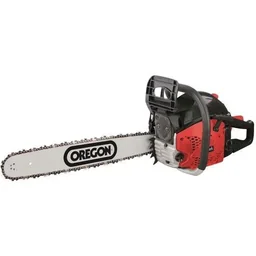
The only safe method is to start it on the ground. Place the chainsaw on a firm, level surface. Make sure the chain can move freely and is not touching any obstacles. Place the toe of your right foot inside the rear handle to secure the saw. Grip the front handle firmly with your left hand and press the saw down. Now pull the starter cord firmly and evenly with your right hand until the engine starts. With models such as the powerful 2-stroke chainsaw CSP5300 (), this support is particularly important.
Your posture while sawing is also crucial for safety and control. Always stand with your feet apart and your knees slightly bent to maintain a stable stance. Hold the saw with both hands and keep it as close to your body as possible. Your left arm should be straight and your right arm bent. Do not overreach to cut a branch. Instead, move your feet and find a new, stable position.
Pro tip
Keep your work area tidy. Remove trip hazards such as loose branches, tools or stones. A secure stance is half the battle when it comes to working safely. The sawn wood can later be used for great projects, perhaps even attractive children’s room decor.
What is kickback and how can I avoid it?
Kickback is the most dangerous reaction of a chainsaw. It occurs when the upper part of the guide bar tip, known as the kickback zone, hits an obstacle such as a branch or hard wood. The chain suddenly catches, and the energy throws the saw uncontrollably upwards and backwards towards the operator.
The most important rule is therefore: never cut with the tip of the guide bar. Always keep an eye on the tip and make sure it is clear of obstacles. A firm two-handed grip helps you control the saw in the event of minor kickback. Modern chainsaws are equipped with a chain brake that activates in the event of kickback and stops the chain within a fraction of a second. Check that it works before every use.
Kickback follows simple physical laws of leverage. At the top of the guide bar, the chain moves towards the operator. If a tooth catches there, the full power of the engine acts as a pivot and catapults the saw upwards. Respecting this zone is vital for survival.
Let the saw do the work. Do not push it; guide it with gentle pressure. Use the bumper spike (felling spike) on the housing as a pivot point. Place it against the wood, then guide the saw through the cut with a slight levering motion. This provides stability and control. Be especially careful when cutting thin, flexible branches, which can easily enter the kickback zone. With these tips and the right equipment, your next project will be not only successful but also safe. Why not take a look at our pop-up sale? You may find more useful helpers for your project, whether you are improving your home or decorating a child’s room.
Frequently asked questions
- How often should I sharpen a chainsaw chain?
- Sharpen your chain as soon as you notice that cutting performance is declining, the saw is producing fine sawdust instead of coarse chips or you need to apply more pressure. With intensive use, this may be necessary several times a day. A sharp chain is the foundation of safe work.
- Can I use regular engine oil instead of chainsaw chain oil?
- No, never use engine oil. Special chainsaw chain oil has the viscosity and adhesive properties needed to stay on the chain at high speed. The wrong oil provides inadequate lubrication, leading to overheating and rapid wear of the guide bar and chain.
- What is the difference between a semi-chisel and a full-chisel chain?
- Full-chisel chains have sharp, square-cornered cutting teeth and cut more aggressively and quickly, but they are more susceptible to dirt and require more frequent sharpening. Semi-chisel chains have rounded teeth, stay sharp for longer and are more forgiving of mistakes, but cut slightly more slowly. For most home users, a semi-chisel chain is ideal.
- Why is my chainsaw smoking while I cut?
- Smoke is almost always a sign of a blunt chain or insufficient lubrication. Friction becomes too high and heats up the wood. Check the oil level and oil supply immediately. If both are fine, your chain is almost certainly blunt and needs sharpening.
- How do I tension the chain when the saw is warm?
- A chain expands when heated. Tension the chain while it is warm so that it can still be pulled easily along the guide bar by hand (wear protective gloves!). Remember to loosen the chain tension again after it has cooled, otherwise it will contract too much.
You may also be interested in
- Chainsaw chain stuck or broken? The 5 most common mistakes and solutions
- Cutting firewood like a pro: 7 chainsaw tips
- How to use a petrol chainsaw safely: The TITAN beginner’s guide
- Titan chainsaw chain vs. standard: Which chain is right for you?
- Seasonal woodcutting: When is it time for a new chainsaw chain?
- Chainsaw chain care and sharpening: How to make your chain last longer