
In brief: An empty workshop trolley offers maximum flexibility for your individual tool setup. You benefit from mobility and can arrange the drawers and compartments yourself. Our test shows that size, the number of drawers, load capacity and wheel quality are the most important buying criteria. A sturdy trolley with good wheels saves you a lot of hassle and improves efficiency in the workshop.
Contents
What is an empty workshop trolley?
An empty workshop trolley is the empty, mobile base for your tools. You get a mobile frame with drawers and possibly additional storage areas, without pre-fitted tool inserts. This empty version gives you maximum freedom. You decide which tools to store and how to organise them.
This concept appeals to anyone who prefers an individual system. Perhaps you already own specialist tools or want to use specific brands. An empty trolley is the perfect basis for this.
The most important buying criteria at a glance
Before choosing a model, you should define your requirements precisely. The following points will guide you through the selection process.
Size and dimensions
Measure the space in your workshop that the trolley needs to fit through. Remember door widths and narrow aisles. The working height is also important. A trolley that is too low will force you to bend constantly.
Number and type of drawers
More drawers allow for finer organisation. Look for sturdy runners and smooth operation. Deep drawers are suitable for long tools, while shallow drawers are ideal for smaller parts. Some models also offer lockable drawers.
Load capacity and stability
The stated load capacity refers to the total weight the trolley can safely carry. Roughly calculate the weight of your tools. A sturdy sheet-steel frame and robust welds are signs of quality.
Wheels and mobility
The wheels are crucial for mobility. Two lockable castors prevent the trolley from rolling away. Check the type of flooring in your workshop. Large rubber-coated wheels protect delicate floors and roll more easily over small obstacles.
Tip: Plan for more storage space than you currently need from the outset. Your tool collection will often grow over time, and a full trolley is reached quickly.
Model comparison
You will find various versions of empty workshop trolleys on the market. We present some typical examples.
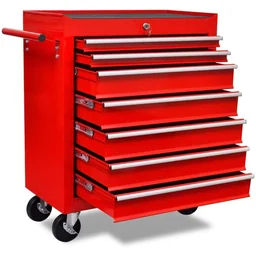
The impresses with seven drawers for excellent organisation. Its red design is popular in many workshops.
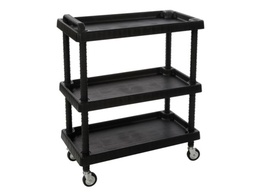
For compact requirements, the is a good choice. With three storage shelves, it provides basic storage while taking up little space.
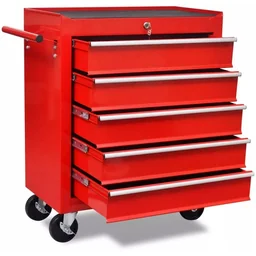
The offers a happy medium with five drawers. It provides good organisation options in a manageable size.
The (GW 4.1) is very compact and manoeuvrable. It is ideal where space is limited.
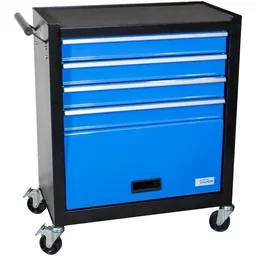
A classic in the workshop trolley category is the (WERKSTATTWAGEN GW 07). Its design is built for durability and versatile use.
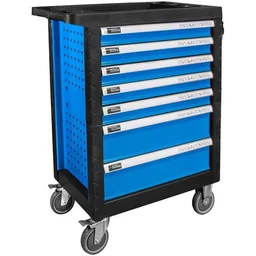
The most highly rated empty workshop trolleys in our range compared directly:
| Model | Customer rating | Availability |
|---|---|---|
| Fritz Göbel 40W cordless LED work light 5500lm - compatible with multi-tools | – | Currently unavailable |
| Fritz Göbel 50W LED work light 4000lm - IP65 for workshops & stables | – | Currently unavailable |
| Red tool trolley with 7 drawers | – | Currently unavailable |
| SONAX SX90 PLUS multipurpose lubricant 5 l - dissolves rust, workshop supplies | – | Currently unavailable |
| Tool trolley - 3 storage shelves - 75 X 37.5 X 92 Cm | – | Currently unavailable |
Warning: Do not overestimate the load capacity. Distribute the load evenly and follow the manufacturer's specifications. Overloading can damage the drawer runners or wheels and compromise stability.
How do you set up your trolley effectively?
Setting it up is the creative part. Start by taking stock of your tools. Sort them by how often you use them. The tools you need most frequently should go in the top drawer or on the work surface.
Use suitable organisation accessories. Inserts, dividers and trays are available for separating drawers. This allows you to find every spanner immediately. Label the drawers if several people use the trolley.

Also think about heavy equipment. Place substantial tools such as hammer drills or pneumatic riveters as low down in the trolley as possible. This creates a low centre of gravity and provides greater stability when moving it.
Note: The perfect setup often develops over time. Stay flexible and do not hesitate to change the layout again after a few weeks of use.
Optimise your workflow
Set up your trolley so that it supports your workflow. If you frequently change work locations, everything you need for a particular task should be in one drawer or positioned directly next to each other. This saves time and unnecessary trips.
Care and maintenance
An empty workshop trolley is a long-lasting investment. With simple care, you can maintain its functionality for years.
Clean the surfaces regularly to remove dust and dirt. This prevents abrasive particles from damaging the drawer runners. Check the tightness of all screws and connections at regular intervals.
The castors require particular attention. Clean them and remove trapped foreign objects such as small stones or metal swarf. On models with ball bearings, these can be regreased after a very long time.
Lubricating the drawer runners
Smooth-running drawers are essential. Use a dry lubricant such as silicone spray or special drawer slide wax on the guide rails. Avoid oil-based lubricants, as they attract dust.
Conclusion and buying recommendation
Choosing the right empty workshop trolley depends heavily on your personal needs. For most DIY enthusiasts and semi-professional users, a trolley with 4-5 drawers is an excellent starting point.
Always prioritise stability and good castors over the number of drawers alone. A wobbly trolley that is difficult to push undermines any organisation. Invest in a solid foundation.
For professional use in the most demanding conditions, it is worth looking for industrial quality. In the DIY sector, the models tested offer very good value for money and perform their job reliably. Choose a size that meets not only your current tool collection but also your future needs.
Frequently Asked Questions
- What are the advantages of an empty workshop trolley?
- An empty workshop trolley offers maximum flexibility. You can organise the drawers and compartments yourself and store exactly the tools you use most often. This allows you to create a mobile system perfectly tailored to your workflow.
- What should I look for in the castors?
- Look for high-quality castors. Two should have brakes to prevent the trolley from rolling away while you work. Plastic castors are suitable for hard floors, while rubber castors are the better choice for delicate floor coverings. The castors must be able to withstand the load.
- How many drawers are ideal?
- The ideal number depends on your tool requirements. More drawers allow for finer organisation, but they often cost more and can be less stable if the quality is poor. For general use, 3 to 5 well-guided drawers are a solid compromise.
- Can I customise any workshop trolley?
- Yes, that is the key advantage. You can equip the drawers with your own tool inserts or sorting trays. When buying, check the internal drawer dimensions so you can find suitable accessories such as tool organisers.
- How much does a typical workshop trolley weigh?
- The unladen weight varies considerably depending on the material and size. Compact sheet steel models often weigh around 15 kg, while large, heavy versions with many drawers can weigh over1735 kg. The trolley's own weight is an indicator of stability.