
In brief: Choosing the right garden hose connector depends on your specific application. Standard couplings are suitable for simple extensions, while complex irrigation systems with several outlets require a water splitter. Pay attention to the material, compatibility with your hose diameters and the type of seal. Our comparison shows which models stand out in terms of durability, ease of use and functionality.
A reliable irrigation system depends on its connections. A leaking or weak hose connector can undo all your gardening work. In our garden hose connector test and comparison 2026, we introduce the most important models. We explain what to look for when buying and which products are the best choice for your needs.
Table of contents
- What types of garden hose connectors are there?
- Buying criteria in the test: what matters
- The best garden hose connectors compared
- Installation and handling in practical testing
- Typical applications for different connectors
- Care and maintenance of your connections
- Buying guide: how to find the right model
What types of garden hose connectors are there?
Not every connector is suitable for every task. The basic distinction lies in its function.
Basic couplings and adapters
These models connect two hoses or adapt different threads to one another. They are the foundation of any garden irrigation system. Straight couplings extend your reach. Elbow fittings help you route the hose around corners without kinking it.
Water splitters (multi-way connectors)
Splitters are the heart of more complex systems. They allow you to operate several devices from one water source at the same time. A 3- or 4-way water splitter is ideal if, for example, you want to use a lawn sprinkler and a watering can in parallel. Some models have shut-off outlets for individual control.
Buying criteria in the test: what matters
We assessed the connectors according to several practical criteria.
Material and workmanship
The material determines the service life. High-quality brass is corrosion-resistant and robust. Stainless steel is a first-class, durable alternative. Galvanised steel offers good protection against rust at a lower price. Look for cleanly cut threads and solid workmanship without sharp burrs.
Compatibility and connection sizes
The most common mistake is choosing the wrong size. The most common connections in the garden are 1/2 inch and 3/4 inch. Some models, such as the
, offer combined connections for maximum flexibility. Before buying, check which threads your taps, hoses and devices use.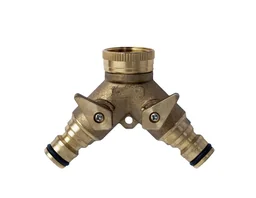
Beware of incompatibility: An adapter between metric and imperial threads may look like a good fit, but it can leak or damage the thread. Use only precisely fitting connectors.
The best garden hose connectors compared
Our comparison introduces selected models from our range.
The highest-rated garden hose connectors from our range compared directly:
| Model | Customer rating | Availability |
|---|---|---|
| 2-way water splitter for 1/2' + 3/4' / tap connection / tap connector 🏆 Test winner | ★ 4,9 (19) | In stock |
| 3-way water splitter | ★ 5,0 (17) | In stock |
| 4-piece hose clamp set, galvanised 10-16 mm | ★ 4,8 (9) | In stock |
| 4-way water splitter | ★ 4,7 (10) | Currently unavailable |
| 1" tap | – | Currently unavailable |
The is a versatile all-rounder. Its combined 1/2' and 3/4' connection makes it the ideal adapter between different system components. The robust brass construction performs impressively in continuous use.
For supplying several outlets at the same time, the
is the first choice. The 3-way water splitter made from sturdy metal enables efficient work in the garden. It is easy and safe to use.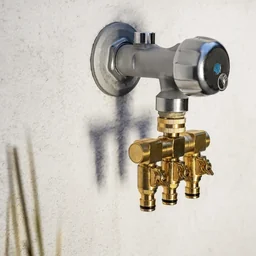
Good hose clamps are essential for securing the hoses themselves. The
offers a practical set in different sizes. The galvanised finish provides reliable protection against the weather.<>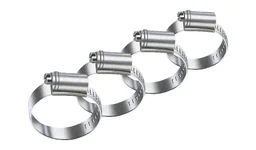
Installation and handling in practical testing
A good connector can be tightened securely without tools.
Leak-proof performance under pressure
We tested all models under full mains pressure. High-quality seals made from EPDM rubber or silicone are the key here. They remain elastic even when temperatures fluctuate. Some models have an additional union nut with an internal seal for double protection.
Ease of use and ergonomics
Knurled or hexagonal surfaces on the union nuts provide a good grip, even with wet hands or gloves. Grooves that are too narrow or smooth can make tightening more difficult. This is an important point in everyday use.
Tip for secure connections: Always tighten union nuts by hand. Avoid using pliers or spanners, as they can crush the seals and damage the threads. Hand-tightening is usually sufficient.
Typical applications for different connectors
Different solutions are recommended depending on the task in your garden.
Setting up irrigation systems
For permanently installed drip irrigation or pop-up sprinklers, permanently watertight connections are essential. Choose brass or stainless steel connectors that can also withstand being installed in the ground. Combine them with suitable hose connectors for the above-ground supply line.
Flexible use with multiple devices
If you frequently switch between a sprinkler, pressure washer and garden hose, a manifold is the most efficient solution. Connect all your devices once and control the water supply directly at the manifold. This saves time and reduces wear on the tap thread.
Note on winter protection: Drain all hoses in autumn and disconnect the connectors. Store them in a frost-free place. Residual water in the connectors can cause cracks in the housing when it freezes, even in metal connectors.
Care and maintenance of your connections
With little effort, your connectors will last for many years.
Rinse out sand and dirt after use. Regularly check the sealing rings for cracks or deformation. These are usually available as replacement parts and are easy to replace. You can occasionally treat smooth-running threads with a special lubricant for drinking water installations.
Buying guide: How to find the right model
Follow a systematic approach to find the right connector.
First, assess your needs: do you need a simple extension, an adapter or a manifold? Then measure the exact connection sizes of your existing components. Next, choose the material according to the level of use and planned storage conditions. Choose quality, because a faulty connector can cause expensive water damage.
With the right hose connectors, watering your garden becomes more efficient, reliable and less work. Our comparison gives you the confidence to make a good buying decision.
Frequently asked questions
- What is the best material for hose connectors?
- Brass and stainless steel are the most durable materials. They do not corrode and can withstand high pressure. Galvanised steel is a cost-effective alternative for less demanding areas. Avoid basic plastic connectors for continuous use, as they become brittle.
- How do I find the right size for my hose?
- Measure the inside diameter of your hose. Common sizes are 1/2 inch (13 mm), 3/4 inch (19 mm) and 1 inch (25 mm). The size stated on the connector packaging usually refers to this inside diameter. You can find suitable hose connectors in our range.
- What is the difference between a coupling and a manifold?
- A coupling connects two hoses to each other. A manifold, also called a multi-way connector, splits one water flow between multiple outlets. For example, a 3-way manifold has one inlet and two outlets. Manifolds are ideal for using multiple devices in parallel.
- Do I need special seals?
- Most connectors have integrated rubber or silicone sealing rings. Check them regularly for cracks. For a completely watertight seal on threaded connections, you can also use hemp or Teflon tape. This prevents the connections from dripping.
- Can I use any hose connector with pressurised water?
- No. Pay attention to the manufacturer's maximum pressure rating. Connectors for garden irrigation can withstand typical household water pressure. For pressure washers or special pump systems, you need reinforced models specifically marked for this purpose.