
In brief: The choice between solar and mains power depends on your priorities. Solar lights offer easy, cable-free installation and no running costs, but they depend on sunlight. Mains-powered lighting delivers consistent, bright and reliable performance regardless of the weather, but requires professional electrical installation. Solar is often ideal for paths and accent lighting, while mains power is better for main areas and security.
Garden Lighting: Solar or Mains Power – Which Is Better?
Whether you want to enjoy your garden in the evening, see paths safely or highlight special features, the right garden lighting makes all the difference. The key question is: do you rely on the power of the sun or the reliability of a power socket? We compare both systems.
Find out where solar lights excel and when installing mains-powered outdoor lighting makes more sense. We cover everything from brightness and costs to installation.
What are the key differences between solar and mains power?
Solar and mains-powered outdoor lighting work on completely different principles. One system is self-sufficient, while the other relies on a power supply.
A garden solar light consists of a solar panel, a rechargeable battery, an LED and electronic components. It stores sunlight during the day and releases it as light at night. It is a self-contained system.
Mains-powered lights need a cable connection to a power source. This may be a permanently installed cable in the ground, an outdoor socket or a low-voltage transformer. They draw their energy continuously from the mains.
Choosing solar or mains power is a fundamental garden-planning decision. Solar is an add-on, while mains power is infrastructure. Plan ahead, especially if you want permanent, bright lighting.
Energy source and independence
Solar lights are completely independent. Put them in place and they work – provided there is enough sunlight. This gives you maximum flexibility when positioning them.
Mains power for the garden means relying on a socket or a fixed connection. In return, it supplies constant energy regardless of the time of day, season or weather. The light shines with the same intensity every night.
Installation and effort
The biggest practical difference is installation. Simply push solar lights into the ground or screw them into place. There are no cables.
For fixed garden lighting powered by the mains, you need to install cables. This requires more planning, work and often an electrician. The result, however, is permanent and powerful.
Pro tip
Combine both systems! Use solar lights for flexible path markers and decorative accents. Install fixed mains-powered lights in key areas such as the patio and front door, or for security. This gives you the best of both worlds.
How bright will the lighting really be?
Brightness is a crucial factor. It is measured in lumens (lm). More lumens mean more light.
Mains-powered LED lights can easily deliver several hundred to a thousand lumens. A bright outdoor lighting spotlight for a house wall can easily provide 1000 lm or more. Its output is guaranteed and consistent.
The reality of solar lights
The brightness of garden solar light models is limited. It depends on the size of the solar panel and the battery capacity. High-quality solar lamps produce 80-150 lumens. Basic path markers often provide less than 50 lumens.
They only reach their stated brightness when the battery is fully charged. Their light output gradually decreases throughout the evening. After several overcast days, it may be greatly reduced.
When comparing solar lights, do not just look at the price. Always check the technical specifications: lumen output, battery capacity in mAh and the size of the solar panel. A large panel charges the battery faster and more fully.
Light colour and atmosphere
Both systems offer different light colours, usually warm white or cool white. Mains-powered lights often offer more adjustment options, such as dimmable models or colour-changing lights.
Solar lights often have a fixed light colour. Check the product description. Warm white (2700-3000 Kelvin) creates a cosy atmosphere, making it ideal for seating areas.
What costs are involved? The complete calculation
Always consider the total cost: purchase, installation and operation.
Comparing purchase costs
Basic solar lights are often cheaper to buy. You can get a set with several path lights for little money. However, high-quality solar lamps with high light output cost considerably more.
Mains-powered lights cover a broad price range. The light itself may be inexpensive. The hidden costs are in the installation: cables, digging, junction boxes and professional labour.
For initially equipping several areas, solar lights are often the more affordable choice. For a powerful, permanent solution, investing in a mains installation can pay off in the long term.
Important note
Work on the 230V power supply outdoors must only be carried out by trained electrical professionals! Faulty installations are life-threatening and can cause significant property damage. Be sure to budget for these costs and have the work inspected and approved.
Running costs and maintenance
This is where the garden solar light clearly wins. Energy from the sun is free, so there are no electricity costs. You only need to replace the battery occasionally, after several years.
Mains-powered lights incur ongoing electricity costs. However, modern LED lights are very energy-efficient. The annual consumption of garden lighting is low. Maintenance is limited to cleaning the lights.
How much installation and maintenance is required?
Installation often determines which option people choose.
Plug and play with solar
Solar lights are the ultimate in simplicity. Find a sunny spot, push the ground spike into the soil or screw the light into place. Done. You can move them at any time.
This is perfect for tenants or if you want to keep your garden lighting flexible. They are also ideal for spontaneous garden parties. Discover suitable accessories in our garden equipment category.
Planning a mains installation
For a fixed installation using mains power in the garden, you need a detailed plan. Where should the lights go? Where will the cables run? How will the power get there? Do you need to dig under paths or paving?
This planning takes time, but it only needs to be done once. The result is a professional, discreet and permanent solution. You can find useful aids for wiring in the garden tools section.
Additional advice
Plug-in low-voltage systems offer a compromise. A weatherproof transformer is placed near a power socket. Low-voltage cables (12V/24V) run from it to the lights. You can install these yourself. You get consistent lighting without the dangers of 230V voltage.
Reliability and lifespan: Which lasts longer?
Both systems use long-lasting LEDs. The weak point is different in each case.
The Achilles' heel of solar lights
For solar lights, the battery is the wearing part. After 2-5 years (approx. 500-1000 charging cycles), its capacity decreases significantly. The lighting duration becomes shorter. Many models allow the battery to be replaced.
They also depend on the weather. In winter, with fewer hours of sunshine, they work poorly or not at all. Dirty solar panels also reduce performance. A product such as the
, a portable solar panel, can be useful here for trickle-charging garden batteries.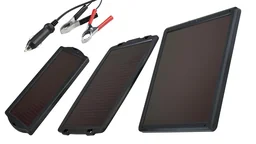
The longevity of mains power
Mains-powered outdoor lights have no problematic batteries. High-quality models are designed to last for decades. The electronics are better cooled and protected.
Their reliability is virtually absolute. When the power is on, the light comes on. The components are better protected against voltage fluctuations. The investment therefore lasts longer.
Where is each system best used?
The best approach is a combination of both. Here is a guide for typical applications.
Solar lights are ideal for
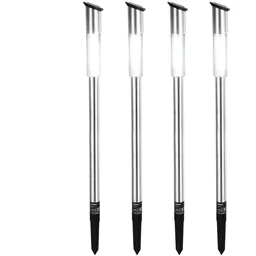
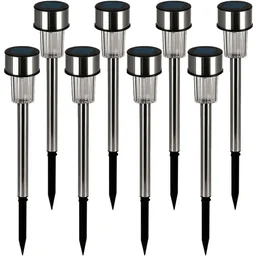
- Path lighting: For marking paths and steps. Sets such as the or the are perfect for this.
- Decorative accents: In flower beds, for backlighting bushes or as table lights.
- Flexible areas: For spaces that have not yet been permanently designed or that change seasonally.
- Hard-to-reach corners: Where no power cable can reach.
Mains power is better for
- Main terrace lighting: For bright, essential light when reading or eating.
- Security lighting: At house entrances, garage driveways or dark corners with motion sensors.
- Lighting trees or facades: High light output is needed here.
- Continuous operation: For lighting that should stay on continuously throughout the night.
When planning your garden, also think about protecting your furniture. Suitable covers for garden furniture protect your outdoor furnishings.
Conclusion: Your decision checklist
Answer these questions to find the ideal system for you.
Choose solar if: Easy, wireless installation is important to you. You do not want ongoing electricity costs. You want to remain flexible. The lighting is mainly decorative or intended for side paths. You want to avoid the effort and expense of installing power cables.
Choose mains power if: You need constant, bright and reliable lighting. The lighting is important for safety (entrance, stairs). You are planning a permanent, professional solution. You want to be independent of the weather and the seasons. The lights need to stay on for long periods.
For most gardens, the smartest solution is a combination. Use the benefits of both worlds for functional and atmospheric outdoor lighting. Start with solar lights for initial accents and plan permanent power points for key areas in the long term. This allows you to create your perfectly illuminated garden one step at a time.
Frequently Asked Questions
- How long do solar garden lights stay on at night?
- Lighting duration varies considerably. After a sunny day, high-quality models with large batteries can provide 8-12 hours of light. Basic path lights often stay on for just 4-6 hours. In winter or under overcast skies, the lighting duration may be significantly shorter or the lights may not come on at all.
- Can I connect 230V garden lighting myself?
- Installing permanently wired 230V cables in the garden should be left to a qualified electrician. Strict regulations apply to outdoor sockets and lights (IP44/IP65 protection ratings). However, you can install ready-made, tested low-voltage systems (12V/24V) with a transformer yourself.
- Which garden lighting is the brightest?
- Mains-powered LED spotlights or lights provide the highest and most consistent brightness. They produce more lumens per light than their solar counterparts. For solar lights, look for a high lumen rating (e.g. 80-150 lm) and a large solar panel. However, their actual brightness rarely reaches mains-powered levels.
- Does stainless steel rust when used for garden lighting?
- High-quality stainless steel (e.g. V2A or 304) is highly rust-resistant and ideal for garden lighting. Cheaper, non-stainless steel with a stainless-steel-look finish can still rust. Check the material specifications. Plastic or aluminium housings are also good, weather-resistant alternatives.
- How do I clean the solar panel on my garden light?
- Clean the panel regularly with a soft, damp cloth. Do not use abrasive cleaners. Dust, bird droppings or leaves can significantly reduce charging performance. Position the light so that rain can naturally clean the panel. A clean surface is the key to a long lighting duration.
You may also be interested in
- Solar energy in the garden: The ultimate guide to solar lights
- Planning patio lighting: Ideas for atmospheric light
- Garden lighting: How to create an atmospheric setting
- Solar lights review and comparison 2026
- Outdoor lighting for burglary protection: Tips for your home
- Reduce electricity costs: Simple tips for your home and garden