
In brief: The location of a heat pump has a major impact on its efficiency and service life. Keep a minimum distance of 3 metres from neighbouring boundaries, check local planning regulations and choose a well-ventilated, shaded position. Avoid confined recesses and direct southern sunlight. Proper impact sound insulation and a frost-proof, level base are essential.
Why the installation location determines success or failure
A heat pump is not simply a box. It is a complex system that extracts heat from the surrounding air, the ground or groundwater. Its efficiency, measured by the seasonal performance factor, depends directly on the conditions at its location. Choosing the wrong position can cost you money through higher electricity consumption and may lead to premature wear.
The three biggest mistakes when choosing a location are insufficient air circulation, poor sound propagation and an unsuitable base. These errors can only be corrected later with considerable effort. Therefore, plan the position with the same care as the choice of the unit itself.
Good planning provides the basis for a reliable and economical heating system for your renovated home.
How do I plan the statutory clearances correctly?
Before breaking ground, clarify the legal requirements. The distance from neighbouring properties is not regulated uniformly across the country. The key factors are your local planning regulations, building regulations and noise protection law. A general guideline is three metres from the property boundary.
Important note
Compliance with the required clearances is not negotiable. A violation can result in the system being shut down. If in doubt, always obtain binding information from your local planning authority. Subsequent consent from a neighbour does not exempt you from public law requirements.
Also take clearances from your own windows, patio doors and living areas into account. The aim is to minimise noise emissions. Modern units are quiet, but even a soft hum can be disturbing during continuous operation. Plan the location so that sound is emitted as freely as possible towards less sensitive areas.
You also need sufficient working space around the unit for installation and maintenance. Allow at least 50 centimetres on the service side. This will also make future work on plumbing and irrigation technology easier.
What type of base is needed for the foundation?
An air-to-water heat pump weighs several hundred kilograms. The foundation must support this load permanently and evenly without sinking. A sinking foundation can distort the system, which may cause leaks in the refrigerant lines. The consequences are expensive repairs and reduced performance.
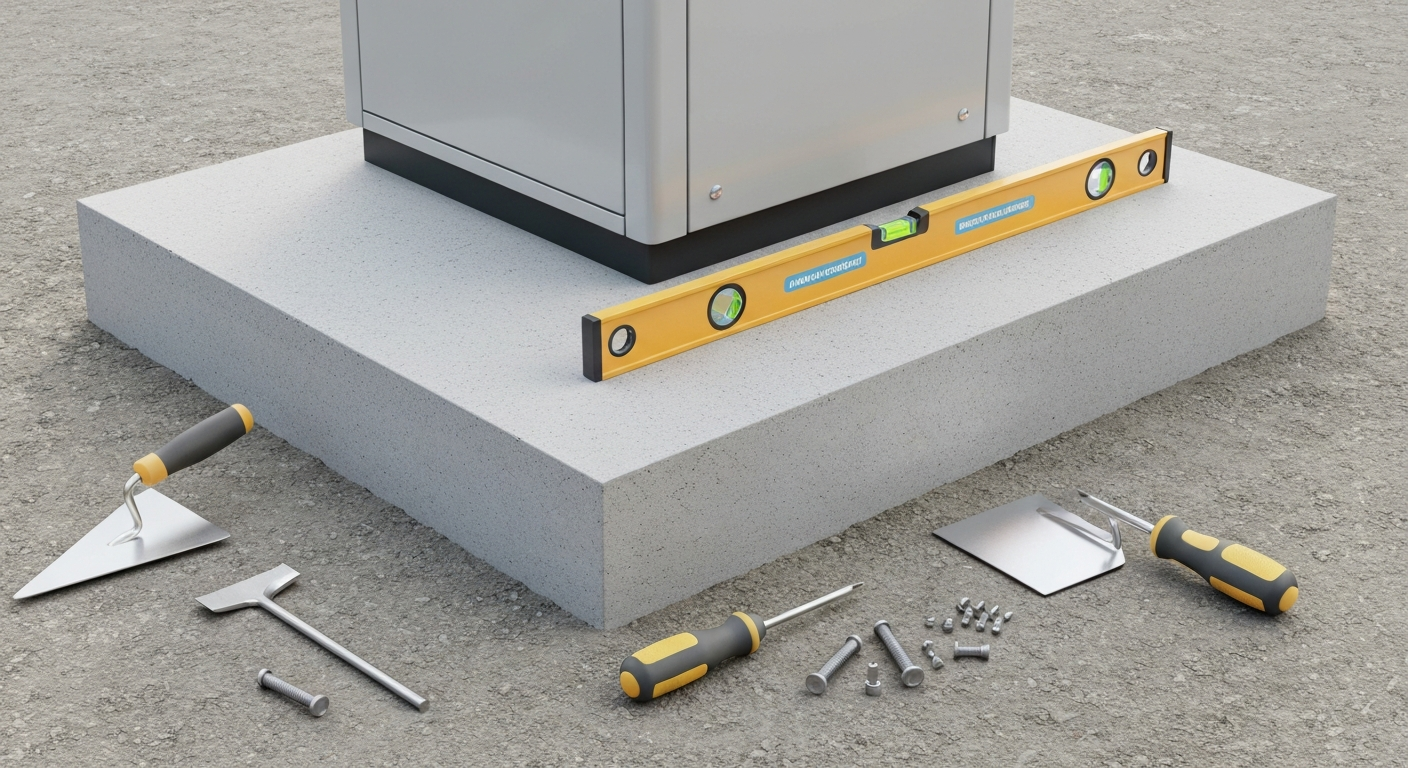
A frost-proof foundation is essential. It prevents ground frost from lifting the base and putting the heat pump out of level. Common options include a reinforced concrete slab at least 80 centimetres deep or several pad foundations. Ask a specialist company to provide a structural calculation for your specific soil conditions.
Pro tip
Integrate professional impact sound insulation between the foundation and the unit from the outset. Special vibration dampers or elastic rubber mounts beneath the feet reduce structure-borne noise. Otherwise, this noise can travel through the ground into the house and be perceived as an annoying hum.
The base must be completely level. Use a spirit level during preparation. A slope creates tension in the unit housing and can obstruct drainage from the condensate tray. You will find suitable materials for all foundation work in our operating supplies category.
Where can I find the best location in the garden?
Finding the perfect spot is a balancing act between technical requirements and practical considerations. The heat pump needs unrestricted airflow from all sides. Avoid cramped corners, obstructed recesses or positions directly in front of a high wall. These locations cause air short-circuiting: the exhaust air that has just been discharged is immediately drawn back in.
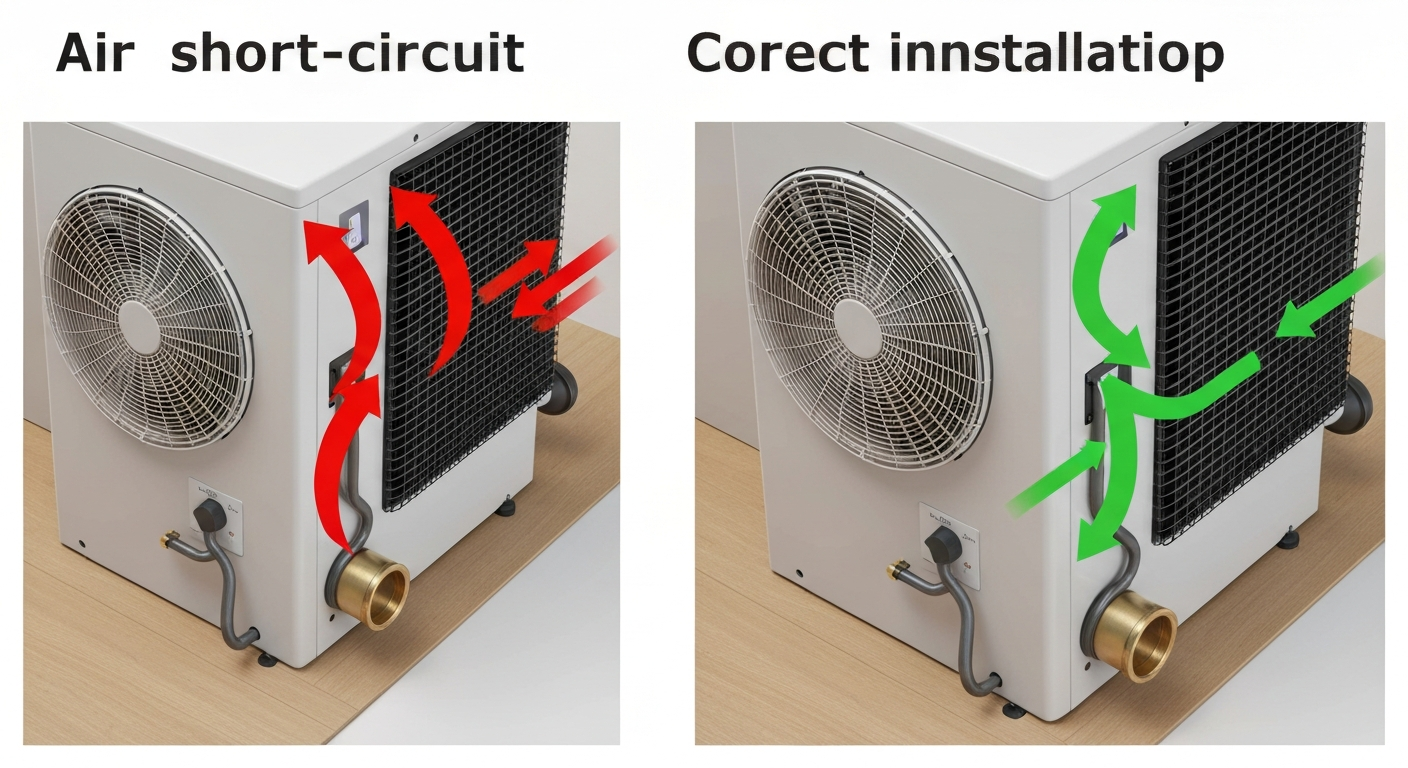
Air short-circuiting has two serious effects. In winter, the intake air cools down more quickly, causing the evaporator to ice up more often. The defrost cycle consumes additional energy. In summer, the heat pump draws in exhaust air that has already been warmed, causing its efficiency to drop dramatically. A clear radius of two metres on the intake and exhaust sides is the minimum.
The single most important measure for efficiency is unrestricted airflow. Do not plan for the space the unit needs, but for the space the air around it needs.
Consider the direction of the sound. Point the noisier exhaust side away from the neighbouring house and your own bedroom windows wherever possible. A natural sound barrier, such as a dense hedge at an appropriate distance, can help. For other garden projects, you will find useful accessories such as mesh sheeting and tarpaulins in our shop.
Which safety precautions are mandatory?
Safety is the top priority when installing a heat pump. The system operates with electrical voltages and a pressurised refrigerant circuit, and it contains moving parts. Ensure that the installation is safe to touch and protects children and pets in particular.
A permanently installed, accessible and clearly labelled main switch near the building is required. This emergency isolator must safely disconnect all live parts of the heat pump from the mains. It is essential in the event of a fire or during maintenance work. The wiring must be installed by a qualified electrician in accordance with DIN standards.
Additional advice
Regularly check the fixings and the condition of the connection cables. Frost, storms or rodents may have caused damage, especially after winter. A quick visual check in spring and autumn helps identify larger problems at an early stage. For general safety equipment, visit Occupational Health & Safety.
Make sure that the unit is stable and protected against accidental impact. If your region experiences heavy snow loads, the system must be designed and secured accordingly. Also consider drainage for the condensate produced. It must be discharged in a frost-proof and odour-neutral way, for example into the household drain or a soakaway bed.
How can I avoid disturbing myself and my neighbours with noise?
The noise from a heat pump consists of fan noise and vibrations. Sound emissions are specified as a sound power level. Compare this value when choosing a unit. Modern inverter models operate significantly more quietly at partial load than older fixed-speed models.
Sound propagation can be influenced by intelligent positioning. Soft surfaces such as lawns, flower beds or ground cover absorb sound better than hard surfaces such as paving or concrete. Do not position the heat pump directly in front of a large, smooth house wall. It acts like a resonating body and reflects the sound.
Many complaints are caused not by units that are too loud, but by unfavourable positioning. A unit may comply with all limit values when measured, yet still be perceived as disturbing because of reflections and the quiet of the night.
An optional acoustic fence can help. Make sure that it does not obstruct the necessary airflow. It must be positioned at a sufficient distance and designed with gaps or special slats. Investing in low-noise mounting systems or a small foundation with integrated insulation pays off in residential areas.
How does sunlight affect performance?
Direct, intense sunlight is an enemy of efficiency. It additionally heats the casing and the air that has already been drawn in. In midsummer, this can unnecessarily reduce the heat pump's cooling capacity in heating mode. A partially shaded location is ideal, for example on the north or east side of the house.
Avoid installing the unit under a roof overhang on the south side without sufficient clearance. Heat can build up here. If only a sunny location is available, consider natural shading. A tall tree that provides leaves in summer but lets sunlight through in winter is a good solution.
Products such as the or the offer reliable performance, allowing you to make full use of their efficiency by choosing the right location. Special models such as the
can also benefit from a cool, shaded installation location for certain applications.
Remember to allow access for maintenance and any repairs. The technician needs space for their tools and must be able to reach all sides of the unit. An overgrown or difficult-to-access location leads to higher service costs. Keep the area around the heat pump clear of leaves and climbing plants. For garden care before and after installation, you will find everything you need in Garden + Outdoor.
What should you consider when installing a heat pump in an older property?
Renovating an older property with a heat pump is an excellent way to improve energy efficiency. However, planning must be particularly thorough in this case. Plots are often smaller, neighbours are closer, and the options for an ideal installation location are limited.
In an older property, pay particular attention to the structural requirements for the planned foundation. Old basement walls or floor slabs that cannot bear the load may need to be reinforced. You must also plan the heating pipes from the installation location to the boiler room. Using existing pipe routes may be a sensible option here.
Noise is often perceived as more disruptive in densely built-up areas. In confined conditions, consider choosing a particularly quiet model or a split heat pump, where the louder compressor is located outdoors and the quieter hydraulic unit is installed inside the house. Suitable can be a useful addition to a renovated home.
Clarify at an early stage whether heritage protection rules or local design regulations impose specific requirements on the installation. Requirements for visual screening or approved materials may limit your choice. A well-thought-out plan is half the battle when it comes to a successful heat pump installation in your renovated home.
Frequently asked questions
- How much space must there be between a heat pump and the neighbour's property?
- A minimum distance of 3 metres from the property boundary is required in many local development plans. This distance reduces noise emissions and ensures unobstructed airflow. Before installation, always check local regulations and discuss the plans with your neighbours to avoid later disputes.
- Can I install a heat pump in the basement?
- A basement is rarely suitable for air-to-water heat pumps because they need to draw in and discharge large volumes of air. Ground-source or brine-to-water heat pumps with ground probes, on the other hand, can be installed in a basement. Adequate ventilation and access for maintenance personnel are essential. Confined spaces cause air recirculation and efficiency losses.
- What should I consider when preparing the foundation?
- The foundation must distribute the load, be frost-proof and completely level. Point foundations or a reinforced concrete slab are commonly used. Include impact sound insulation to minimise vibrations. The ground must remain permanently load-bearing to prevent settlement and misalignment of the heavy heat pump.
- Does a wind-protected location improve efficiency?
- No, the opposite is true. A heat pump needs free, unobstructed airflow. Wind protection such as dense hedges or walls can redirect discharged air back into the intake, causing air recirculation. This increases the risk of icing in winter and causes a significant drop in efficiency. Choose a well-ventilated location.
- Do I need planning permission to install a heat pump?
- Often not, but a building notification is usually required. Exceptions include listed buildings, special locations outside built-up areas or installation in the façade. Whether planning permission is required depends on the federal state and local council regulations. Always clarify this in advance with your local building authority to avoid costly modifications.
You may also be interested in
- Installing a heat pump yourself: step-by-step guide
- Installing a heat pump indoors: make the most of the benefits
- Heat pumps: costs, installation and operation explained
- Sizing a heat pump: planning efficient heating systems
- Air-to-water heat pumps: how they work, costs and installation
- Operating a heat pump quietly: avoid disputes with neighbours