
In brief: Place the trampoline on a level, stable lawn with a clear safety zone all around it. Anchor the frame, fit the safety net and edge padding correctly, and regularly check the springs, mat and poles. An adult should supervise jumping, and only one child should use the garden trampoline at a time.
A garden trampoline adds movement to everyday life and quickly becomes the center of every play session. To keep this outdoor play equipment safe, the location, proper assembly and clear usage rules all matter. Even small setup mistakes can make the frame unstable or reduce the safety zone.
Start by planning the space, then choose a model with the right diameter. Also consider who will use the trampoline, how you will control access and how you will protect it from the weather. This keeps jumping fun and the garden area organized.
Why does a garden trampoline need a stable location?
Jumping creates fast, repeated loads. The jumping mat absorbs the force, transfers it through the springs or bungee cords into the frame and then through the legs into the ground. If the trampoline is tilted or individual feet slide, the load is no longer distributed evenly.
A level location keeps the frame in its intended position. The safety net stays taut, the edge padding fully covers the outer area and the entry height remains unchanged. On sloping ground, the entire frame can move or tip over, especially when children jump at the same time.
What makes a location safe?
The ground must be stable, level and free of sharp objects. Lawn is often a good choice, provided the ground is not waterlogged and there are no deep roots, stones or open holes in the soil. Check the area again after heavy rain before children use the trampoline.
You need a clear safety zone around the trampoline. Maintain the distance specified by the manufacturer in the assembly instructions. Fences, walls, patio furniture, pools, ponds, play towers and hard edges must not be within this area.
“Only one child should jump on the trampoline at a time.”
How do you find the right place for a trampoline?
Do not measure only the diameter of the jumping area. Mark out the entire footprint, including the safety zone and access point. A model with a three-meter diameter needs considerably more space than the circular area alone suggests, because children need room around it when getting on, getting off and playing.
Measure the safety zone
Position the trampoline so children can get on from a clear side. Do not place the access point directly beside a patio, garden path or low wall. Remove loose objects such as balls, watering cans, stools and flower pots from the surrounding area.
Allow enough room above the trampoline as well. Branches, clotheslines, awnings, roof overhangs and cables must not hang above it. A falling branch can damage the net, a cable creates an additional hazard and an awning restricts freedom of movement.
Prepare the ground
Check the area with a long straightedge or a straight piece of wood. You can spot small uneven areas by placing the straightedge in several locations. Remove stones and roots. Fill dips with suitable soil and compact the area afterward.
Do not place the feet on loose boards, individual paving stones or temporary supports. These aids can shift or sink to different depths. If the ground is permanently soft, boggy or steeply sloped, choose another location or have the area professionally prepared.
Consider wind and visibility
A trampoline catches wind like a sail. Do not position it at an open edge of the property if strong gusts occur there regularly. Anchor the frame with suitable ground anchors or a fastening system approved by the manufacturer.
Also choose a location that you can see from the house, patio or a frequently used seating area. Being able to see the trampoline does not replace supervision, but it makes monitoring easier. Young children in particular should not play on the outdoor equipment unsupervised.
Pro tip
Mark out the location first with string or garden markers. Then temporarily place patio chairs, fence sections and other fixed obstacles around it. This will show whether the safety zone really stays clear and whether access is practical.
How do you set up the trampoline correctly?
Read the assembly instructions in full before taking any parts out of the packaging. Lay out the frame sections, legs, springs or bungee cords, jumping mat, safety net, poles, edge padding and fastening hardware separately. Check the parts list. A missing part cannot later be replaced with any screw or another cord.
Assemble the frame and legs
Connect the frame sections on a level surface. Make sure the plug-in connections lock fully into place and that all screws are fitted with the specified washers. Tighten the connections as instructed without overtightening the threads.
Fit the legs symmetrically. Then carefully turn the frame over and check that every foot is fully in contact with the ground. The trampoline must not wobble. If one foot does not touch the ground, correct the surface and do not place loose objects under the leg.
Attach the jumping mat and springs evenly
Attach the jumping mat following the cross pattern in the assembly instructions. First tension opposite points, then work your way around the frame. This distributes the pulling force evenly and makes it easier to attach the final springs or bungee cords.
Use the supplied tensioning tool if the manufacturer provides one. Do not reach between the spring, hook and frame while tension is being applied. Check every connection to make sure it is correctly seated. A part hooked in at an angle can come loose or place uneven strain on the mat.
Attach the safety net and edge padding
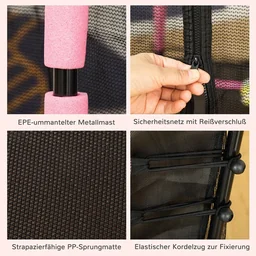
Install the net poles in the specified order and secure the upper connections. The net must be fully closed all the way around. The entry opening needs a functional closure that cannot open by itself.
The edge padding must completely cover the frame and all springs. Attach the padding at the designated points. It must not slide onto the jumping surface or leave any gaps over the springs. Check the fit again after the first few jumps.
Suitable garden play equipment:
Important note
Do not use the trampoline until the frame, jumping mat, net, edge padding and anchoring have been fully installed. Improvised fastenings, missing poles or damaged springs must not be used. Keep the garden play equipment out of use until it has been repaired.
Which rules make jumping safe?
A safe setup is not enough. Children need clear, concise rules that all users understand. Display the most important rules clearly near the entrance and discuss them before the first use.
One person, one jumping surface
Only one child should jump on the jumping surface at a time. Several children increase the risk of collisions and uncontrolled landings. This also applies when siblings are roughly the same size. Wait until the first person has left the mat and closed the entrance.
- Jump on the mat without shoes.
- Remove jewellery, keys and hard objects.
- Keep away from the net and poles.
- There is no pushing, wrestling or catching on the trampoline.
- Only perform somersaults if the manufacturer expressly approves the model for this and qualified instruction is available.
- Enter and leave through the designated opening.
Supervision and weather
An adult should actively supervise young children. They should enforce the rules, consider the users' height and monitor their behaviour on the mat. Do not let children jump unsupervised just because the safety net is closed.
Keep the trampoline closed in rain, thunderstorms, ice, snow or strong winds. A wet mat becomes slippery. Water, snow and ice also increase the strain on the material and can affect the frame or anchoring.
“A trampoline must be stable and must not have any damaged parts.”
How do you maintain and secure your garden play equipment?
Check the trampoline regularly and again after strong winds. A quick visual inspection before each use takes only a few minutes. It helps identify loose parts before children step onto the mat.
Check these parts regularly
- Frame: Look for bent, cracked or corroded parts.
- Legs and anchoring: Check that all feet are stable and the ground anchors are not loose.
- Trampoline mat: Look for cracks, frayed seams and faded areas.
- Springs or bungee cords: Check the fastenings, tension and any damage.
- Safety net: Check the netting, poles, padding and entry closure.
- Safety padding: It must be securely fitted and fully cover the frame and springs.
Replace damaged components with original or explicitly compatible spare parts. Do not mix springs, bungee cords or nets from different models. The dimensions and load capacities can differ even between trampolines of a similar size.
Choose a suitable cover
A cover keeps leaves, bird droppings and some UV radiation away from the trampoline mat. It does not replace inspections or prevent storm damage. Secure the cover so that it does not flap in the wind or collect water.
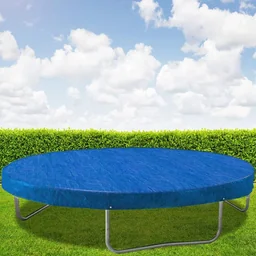
is a blue cover for trampolines with a diameter of 183 centimetres. fits models with a diameter of 305 centimetres. Before choosing a cover, check the exact diameter, the shape of the frame and the intended fastening points.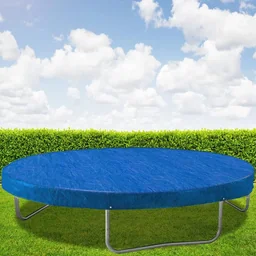
Prepare for the winter break
Follow the manufacturer's instructions for the winter break. Depending on the model, remove the net, safety padding or the entire trampoline. Store dry parts in a clean, frost-free place. Do not allow snow to accumulate on the trampoline mat unless the model is explicitly designed for it.
Additional advice
Record the date of the last safety inspection directly in your garden calendar. Check the trampoline thoroughly at the start of every gardening season and again after storms, frost or extended periods of non-use. This way, you will not forget the anchoring, net, springs or safety padding.
What size is right for your garden?
The right size depends on more than just the children's age. The available garden space, the safety zone and whether you want to leave the trampoline up permanently or store it seasonally are all important factors. A smaller model is often easier to supervise in a compact garden.
Measure the available space before buying
Measure the area between fixed boundaries. Take fences, house walls, garden sheds, patios, trees and paths into account. Subtract the required clearance from the usable space. Only then compare the model size and frame dimensions.
A children's trampoline with a safety net can be a sensible choice for small gardens if the jumping area and safety zone fit completely. Do not buy a larger model simply because several children are going to use it. The rule of one person per mat still applies.
Fit the trampoline around the rest of your garden
Plan the location so that the lawnmower, garden hose and garden paths remain accessible. Clear pathways prevent children from having to walk between furniture and equipment to reach the trampoline. For more ideas for play, leisure and outdoor equipment, explore the relevant offers in the Garden + Outdoor category.
The rest of your garden equipment should not narrow the safety zone either. Place seating, parasols and mobile play equipment outside the jumping area. Under Garden, you will find more solutions for a family-friendly outdoor space.
If you are designing the garden as a play area, keep different activities separate. A garden playhouse or ride-on vehicle also needs a clear area. This prevents paths from crossing the trampoline entrance.
Checklist before the first jump
- The location is level, stable and free of obstacles.
- The safety zone around and above the trampoline remains clear.
- All frame sections, legs and connections are secure.
- The trampoline mat is evenly tensioned.
- The net, poles, safety padding and entrance are correctly fitted.
- The trampoline is stable and anchored against the wind.
- All users know the rules.
- An adult is responsible for supervision.
With this preparation, the trampoline remains a reliable place for exercise in the garden. Check the setup regularly, respond immediately to signs of wear and adapt the rules to the users. This allows the garden play equipment to combine exercise, play and family time without unnecessary risks.
Frequently Asked Questions
- How much space does a trampoline need in the garden?
- A trampoline needs a level, firm and obstacle-free location. Leave the safety zone around the frame required by the manufacturer clear, remove stones and branches, and secure the model against wind. Do not place it next to a pond, wall, fence or play tower, or beneath low-hanging branches.
- What type of ground is suitable for a garden trampoline?
- A trampoline should not be placed on concrete, asphalt or steeply sloping ground. Grass is suitable if the ground is stable, level and free from roots, stones and standing water. Level out minor uneven areas properly. Then check that all the feet are fully supported.
- What are the rules for using a trampoline?
- Only one child should use the mat at a time. Shoes, jewellery and hard objects must be left outside. An adult should supervise young children, check the safety net and stop use during rain, thunderstorms, strong winds or if any components are damaged. Enforce these rules consistently.
- Do I need a cover for my trampoline?
- A cover protects the jumping mat from leaves, UV radiation and light dirt. Choose a cover based on the actual diameter and attach it according to the manufacturer's instructions. Remove water and snow before anyone jumps, and store the cover somewhere dry if it does not fit properly.
- Can a trampoline be placed in a small garden?
- Yes, a trampoline can also be placed in a small garden if there is enough room for the safety zone, access and a clear line of sight. First measure the footprint, including the surrounding free space. A smaller model is more suitable than a large one positioned too close to a fence, patio, tree or garden shed.
You may also be interested in
- Garden play equipment: safety tips for carefree fun
- Setting up a pool in the garden: the ultimate guide
- Build your own children's play area in the garden: how to plan play and safety
- Outdoor games for children: ideas for fun and games in the garden
- Gardening with children: fun and learning in the family garden
- Adventure outdoors: camping in your own garden