
In brief: You can size your pond pump correctly by knowing the pond volume and applying the desired turnover rate. For a filter pond, circulate all the water every 1-2 hours. Calculate: pond volume (m³) x desired turnover rate per hour = required flow rate in liters per hour. Add a 10-20% power reserve for height differences and dirt.
How to Size a Pond Pump: Calculate the Right Capacity
The right pump is the heart of your garden pond. It moves water to the filter, brings your stream to life and prevents algae growth. Incorrect sizing leads to cloudy water, overloaded equipment and high electricity costs. We show you how to calculate the perfect capacity.
Important note
Manufacturers' flow rate specifications usually refer to the ideal value at zero meters of head height. In practice, this value is reduced by rises, hose lengths and resistance in the filter. Always plan for a 10-20% power reserve.
Why is the right pump capacity so important?
A pond pump has two main jobs. It transports water to the filter system, where dirt and nutrients are removed. At the same time, the movement adds oxygen, which is vital for fish and microorganisms. If the pump is too weak, the water stagnates. Algae and pollutants build up.
If it is too powerful, the filter gets flushed through. Biological processes do not have enough time to work. The water remains cloudy even though the equipment is running. Correct sizing creates a biological balance. It also saves energy and protects your equipment.
The most common mistake is underestimating the head height. Many pond owners buy based on pond size but forget that the pump also has to push the water uphill to the filter. That uses up capacity.
How do I calculate my garden pond's volume?
Everything starts with the pond volume. Only when you know how much water needs to be moved can you choose the right pump. For rectangular or square ponds, multiply the length, width and average depth in meters. The result is cubic meters. One cubic meter equals 1000 liters.
For irregular shapes, mentally divide the pond into simple geometric shapes. Calculate each one separately and add the volumes together. A rough estimate using the average depth is better than no calculation at all. For the girls' toy or family area, plan shallower zones.
Pro tip
Measure the depth at several points. Calculate the average. In ponds with steep slopes, such as swimming ponds, the average depth may be only 60% of the maximum depth. Use online calculators for complex shapes.
Formula for standard pond shapes
- Rectangle/Square: Volume (m³) = length (m) x width (m) x average depth (m)
- Round pond: Volume (m³) = radius (m) x radius (m) x 3,14 x average depth (m)
- Oval shape: Approximate using a rectangle or two semicircles and a rectangle.
Multiply the volume in cubic meters by 1000 to get the number of liters. Example: A pond measuring 3x5 meters with a depth of 0,8 meters holds 12 cubic meters or 12.000 liters.
What circulation rate does my pond need?
The circulation rate indicates how often all the water in the pond should pass through the filter per hour. It is the key to sizing your pump. For a purely ornamental pond without fish, circulating the water every three to four hours is sufficient. The water stays in motion, which helps inhibit algae growth.
A pond with goldfish or minnows needs more. Plan to circulate the water every one to two hours. The increased nutrient load from food and waste requires stronger filtration. For koi ponds or heavily stocked ponds, circulate the water at least once an hour.
The circulation rate is not a fixed number. Observe your pond. Clear water and healthy fish show that the rate is right. If the water becomes cloudy after adding fish, the pump capacity often needs to be increased.
Circulation rates at a glance
- Ornamental pond (without fish): 0.25 - 0.3 times per hour (every 3-4 hours)
- Pond with a few fish: 0.5 - 1 time per hour (every 1-2 hours)
- Fish pond (goldfish): 1 - 1.5 times per hour
- Koi pond: 1.5 - 2 times per hour (at least!)
How do I calculate the required flow rate?
Now combine the volume and circulation rate. The formula is simple: pond volume in litres x circulation rate per hour = required flow rate in l/h. For our example pond with 12.000 litres and fish, this means: 12.000 l x 1.0 /h = 12.000 l/h.
The pump should therefore be able to circulate 12.000 litres per hour. However, this is the value under ideal conditions without any difference in height. The actual performance will be lower. Choose a pump whose rated capacity exceeds this target. The
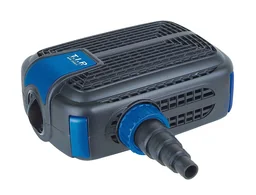
Additional advice
Do not forget to allow for circulation in streams or water features. These require additional capacity. Calculate the flow rate for the filter and water feature separately, then add them together. A pump such as the
can often handle both tasks.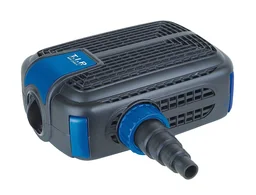
For a decorative fountain or a small waterfall next to the children's rug in the garden shed, a separate solar pump is often sufficient. It creates a cosy atmosphere without putting additional strain on the filter circuit.
What is head height and why is it critical?
Head height is the second key measurement. It indicates how many metres the pump can move water vertically upwards. Every metre of hose, each bend and every filter resistance reduces performance. Manufacturers provide performance curves. They show how the flow rate decreases as the head height increases.
Measure the height difference between the pump in the pond and the outlet at the filter or stream. Add 0,1 metres of head height per metre of hose length and 0,5 metres for each filter in the system. Find the flow rate at your total head height in the performance curve for your chosen pump. This value must match your target flow rate.
Head height calculation example
Pump is in the pond. Filter inlet is 1,5 metres higher. Hose length is 5 metres. There is one filter in the system.
Calculation: 1,5 m (height) + (5 m x 0,1) + 0,5 m (filter) = 2,5 metres total head height.
A pump rated at 5.000 l/h at 0 metres may only deliver 3.000 l/h at 2,5 metres.
For a complex system with several consumers, a powerful multi-function pump is worthwhile. The
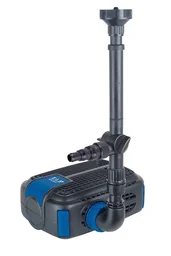
Solar pump, filter pump or multi-function pump?
The type of pump depends on how you intend to use it. A solar pond pump such as the
is perfect for small, decorative water features. It only runs in sunlight, requires little maintenance and is easy to install. It is unsuitable for reliable filtration.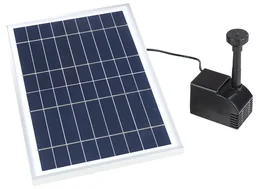
Filter pumps are designed for continuous operation. They pump water to an external filter. Multi-function pumps combine filtration with the option of supplying water features or streams. They are the all-rounders for demanding ponds. Their performance can be scaled, as shown by the WPF 1500 S to 3500 S series.
The choice also depends on your overall system. If you are planning a safe, shallow water play area with baby toys in the garden, a low-powered, child-safe solar pump is the right choice.
Adjusting Pump Performance: Practical Tips
Theory provides a guideline. Monitor your pond closely during the first few weeks after commissioning. If the water is still cloudy after two weeks, the turnover rate may be too low or the filter may be overloaded. A more powerful pump could be the solution.
If the stream is only a trickle even though the pump has been sized adequately, check the pumping height and hose diameter. Hoses that are too narrow restrict the flow. Check the pump pre-filter for dirt and debris. Leaves and algae can halve the performance. Clean it regularly.
Keep the seasons in mind. In summer, when temperatures are high, the pond needs more oxygen. A variable-speed pump that you can turn up is an advantage. In winter, reduce the performance or switch the pump off so as not to disturb fish during their winter dormancy.
Keep an Eye on Energy Efficiency and Costs
A correctly sized pump saves money. An excessively powerful pump uses unnecessary electricity. Check the wattage and calculate the annual costs. Modern pumps with EC or DC technology are more economical than older models with asynchronous motors.
Keep the pump running continuously. Constantly switching it on and off uses more energy and puts additional strain on the technology. At night, you can reduce the output of adjustable pumps. Investing in a high-quality, efficient pump pays for itself over the years through lower electricity bills.
For equipment around the home and garden, whether for the pond or setting up a nursery, choosing durable, efficient technology is always worthwhile.
Conclusion: Calculation Is the Key to Clear Water
You can find the right pond pump by using a systematic calculation. Determine the volume, choose the appropriate turnover rate for your type of pond and calculate the required flow rate. Then use the pumping height to check which pump model can deliver this value in practice.
Allow for spare capacity to accommodate dirt and future extensions. Rely on proven technology such as the WPF series multifunction pumps for filters and streams, or choose solar solutions for decorative features. With the right pump, you can create a biological balance and enjoy your clear, vibrant garden pond for many years.
Frequently asked questions
- How often should pond water be circulated each day?
- For a clear pond with a filter, experts recommend circulating the entire water volume at least every two hours. That means 12 times a day. With a high fish stock or strong sunlight, circulating the water every one to one and a half hours may be advisable. The pump should therefore run 24 hours a day.
- Which is more important: flow rate or delivery head?
- Both values are crucial and are interdependent. The flow rate indicates how much water the pump moves at zero metres of head. The delivery head shows how high it can pump the water. The higher the stream or filter is positioned, the more the effective flow rate decreases. Always choose a pump based on the required delivery head.
- Can a pond pump be too powerful?
- Yes. An oversized pump can cause problems. Water flows through the filter too quickly, reducing its cleaning performance. Fish become stressed, and fine particles are not allowed to settle. Energy consumption and costs also increase unnecessarily. Choose a pump that matches the pond volume and equipment.
- Solar pond pump or mains operation?
- Solar pumps such as PRODUCT_131312 are ideal for small water features without a filter. They are easy to install and inexpensive to run. For filter systems and reliable, constant water circulation, a mains-powered pump is essential. It provides the power and running time needed for crystal-clear water.
- How do I clean and maintain my pond pump?
- Remove leaves and dirt from the pump pre-filter every two weeks. Before winter, take the pump out of the pond, clean it thoroughly and store it in a frost-free place. Check the seals regularly. Proper maintenance significantly extends the pump's service life.
You may also be interested in
- Pond Pump Review & Comparison 2026
- Choosing a Garden Pump: The Ultimate Guide 2024
- Pond Bird Protection: Buying the Right Pond Cover
- Creating a Garden Pond: How to Integrate a Water Feature Harmoniously
- Green Pond Water: Causes and Solutions for Clear Water
- External Pond Pump or Submersible Pump? The Complete Comparison