
In brief: To size your pond pump, start with the pond volume and choose a turnover rate. For a pond with a filter, aim to circulate all the water every 1-2 hours. Calculate the required flow rate in liters per hour by multiplying the pond volume (m³) by the desired turnover rate per hour. Add a 10-20% power reserve for head height and debris.
How to Size a Pond Pump: Calculate the Right Flow Rate
The right pump is the heart of your garden pond. It moves water through the filter, keeps your stream flowing and helps prevent algae growth. A pump that’s the wrong size can leave water cloudy, overload equipment and increase electricity costs. Here’s how to calculate the right flow rate.
Important note
Manufacturers’ flow rate specifications usually show the ideal output at zero meters of head height. In practice, rises, hose length and filter resistance reduce the flow rate. Always allow for a 10-20% power reserve.
Why is the right pump capacity so important?
A pond pump has two main jobs. It moves water through the filter system, where dirt and nutrients are removed. It also keeps the water moving and adds oxygen, which fish and microorganisms need. If the pump is too weak, the water can stagnate and algae and pollutants can build up.
If it is too powerful, water can pass through the filter too quickly for biological processes to work effectively. The water may remain cloudy even while the equipment is running. Correct sizing supports a healthy biological balance, saves energy and protects your equipment.
The most common mistake is underestimating the head height. Many pond owners choose a pump based on pond size but forget that it also has to push water uphill to the filter. That reduces its capacity.
How do I calculate my garden pond's volume?
Start by calculating the pond’s volume. Once you know how much water needs to circulate, you can choose the right pump. For a rectangular or square pond, multiply its length, width and average depth in meters. The result is the volume in cubic meters. One cubic meter equals 1,000 liters.
For an irregularly shaped pond, divide it into simple geometric shapes. Calculate each section separately and add the volumes together. A rough estimate based on the average depth is better than no calculation. For a play area or family area, plan for shallower zones.
Pro tip
Measure the depth at several points and calculate the average. In ponds with steep slopes, such as swimming ponds, the average depth may be only 60% of the maximum depth. Use an online calculator for complex shapes.
Formula for standard pond shapes
- Rectangle/Square: Volume (m³) = length (m) x width (m) x average depth (m)
- Round pond: Volume (m³) = radius (m) x radius (m) x 3,14 x average depth (m)
- Oval shape: Estimate using a rectangle or two semicircles and a rectangle.
Multiply the volume in cubic meters by 1,000 to get the number of liters. Example: A pond measuring 3x5 meters with a depth of 0,8 meters holds 12 cubic meters or 12.000 liters.
What circulation rate does my pond need?
The circulation rate tells you how often all the pond water should pass through the filter each hour. It is the key to sizing your pump. For a purely ornamental pond without fish, circulating the water every three to four hours is usually enough. Keeping the water moving can help inhibit algae growth.
A pond with goldfish or minnows needs more circulation. Aim to circulate the water every one to two hours. The extra nutrients from food and waste call for more filtration. For koi ponds or ponds with many fish, circulate the water at least once an hour.
The circulation rate is not a fixed number. Keep an eye on your pond. Clear water and healthy fish are signs that the rate is right. If the water turns cloudy after you add fish, you may need a pump with a higher flow rate.
Circulation rates at a glance
- Ornamental pond (without fish): 0.25 - 0.3 times per hour (every 3-4 hours)
- Pond with a few fish: 0.5 - 1 time per hour (every 1-2 hours)
- Fish pond (goldfish): 1 - 1.5 times per hour
- Koi pond: 1.5 - 2 times per hour (at least!)
How do I calculate the required flow rate?
Now combine the pond volume and circulation rate. The formula is simple: pond volume in liters x circulation rate per hour = required flow rate in l/h. For our example pond with 12.000 liters and fish, the calculation is: 12.000 l x 1.0 /h = 12.000 l/h.
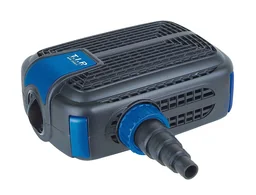
The pump should therefore be able to circulate 12.000 liters per hour. However, that figure assumes ideal conditions with no difference in height. Actual performance will be lower. Choose a pump with a rated capacity above your target. The
Additional advice
Remember to allow for streams and water features, which need extra capacity. Calculate the required flow rate for the filter and water feature separately, then add them together. A pump such as the
can often handle both jobs.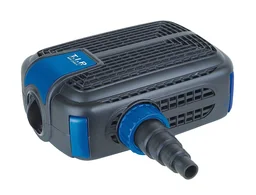
For a decorative fountain or small waterfall next to the children’s rug in the garden shed, a separate solar pump is often enough. It creates a cozy atmosphere without putting extra strain on the filter circuit.
What is head height, and why is it critical?
Head height is the second key measurement. It indicates how many metres the pump can move water vertically. Every metre of hose, each bend and any filter resistance reduces performance. Manufacturers provide performance curves showing how the flow rate decreases as head height increases.
Measure the height difference between the pump in the pond and the outlet at the filter or stream. Add 0,1 metres of head height per metre of hose and 0,5 metres for each filter in the system. Find the flow rate at your total head height on the performance curve for your chosen pump. This value must match your target flow rate.
Head height calculation example
The pump is in the pond. The filter inlet is 1,5 metres higher. The hose is 5 metres long, and there is one filter in the system.
Calculation: 1,5 m (height) + (5 m x 0,1) + 0,5 m (filter) = 2,5 metres total head height.
A pump rated at 5.000 l/h at 0 metres may deliver only 3.000 l/h at 2,5 metres.
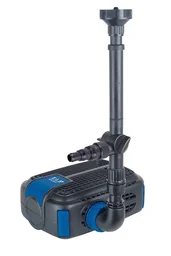
For a complex system with several water features, a powerful multi-function pump is a good choice. The
Solar pump, filter pump or multi-function pump?
The right type of pump depends on how you plan to use it. A solar pond pump such as the
is ideal for small, decorative water features. It runs only in sunlight, requires little maintenance and is easy to install. However, it is not suitable for reliable filtration.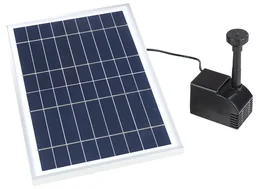
Filter pumps are designed for continuous operation and pump water to an external filter. Multi-function pumps combine filtration with the option to supply water features or streams. They are versatile all-rounders for demanding ponds. Their performance can be scaled to your needs, as shown by the WPF 1500 S to 3500 S series.
Your choice also depends on your overall setup. If you are planning a safe, shallow water play area with baby toys in the garden, a low-powered, child-safe solar pump is a good choice.
Adjusting Pump Performance: Practical Tips
Theory provides a useful guideline, but monitor your pond closely during the first few weeks after setup. If the water is still cloudy after two weeks, the turnover rate may be too low or the filter may be overloaded. A more powerful pump could solve the problem.
If the stream is only trickling even though the pump is correctly sized, check the pumping height and hose diameter. Hoses that are too narrow restrict water flow. Check the pump pre-filter for dirt and debris, too. Leaves and algae can cut performance in half, so clean it regularly.
Keep the seasons in mind. In summer, high temperatures increase the pond's need for oxygen. A variable-speed pump that you can turn up is an advantage. In winter, reduce the flow or switch the pump off to avoid disturbing fish during their winter dormancy.
Keep an Eye on Energy Efficiency and Costs
A correctly sized pump can save you money. An oversized pump uses unnecessary electricity. Check the wattage and calculate the annual running costs. Modern pumps with EC or DC technology are more energy-efficient than older models with asynchronous motors.
Keep the pump running continuously. Constantly switching it on and off uses more energy and puts extra strain on the equipment. At night, you can reduce the output of an adjustable pump. Investing in a high-quality, energy-efficient pump can pay off over the years through lower electricity bills.
Whether you are choosing equipment for your pond or setting up a nursery, durable, energy-efficient products are always a worthwhile choice.
Conclusion: Calculation Is the Key to Clear Water
A systematic calculation helps you find the right pond pump. Determine your pond's volume, choose the appropriate turnover rate for your type of pond and calculate the required flow rate. Then factor in the pumping height to check which pump model can deliver that flow rate in practice.
Allow for extra capacity to account for dirt and future additions. Choose proven technology such as the WPF series multi-function pumps for filters and streams, or opt for a solar pump for decorative water features. The right pump helps create a biological balance and keeps your garden pond clear and vibrant for years to come.
Frequently asked questions
- How many times should pond water circulate each day?
- For a clear, filtered pond, experts recommend circulating the entire water volume at least once every two hours. That works out to 12 times a day. If you have a lot of fish or strong sunlight, circulating the water every one to one and a half hours may be advisable. The pump should therefore run 24 hours a day.
- Which matters more: flow rate or delivery head?
- Both values are essential and interdependent. The flow rate indicates how much water the pump moves at zero metres of head. The delivery head shows how high the pump can move the water. The higher the stream or filter is positioned, the more the effective flow rate decreases. Always choose a pump based on the required delivery head.
- Can a pond pump be too powerful?
- Yes. An oversized pump can cause problems. Water flows through the filter too quickly, reducing its cleaning performance. Fish can become stressed, and fine particles may not have time to settle. Energy consumption and costs also rise unnecessarily. Choose a pump that matches your pond's volume and equipment.
- Should I choose a solar pond pump or a mains-powered pump?
- Solar pumps such as PRODUCT_131312 are ideal for small water features without a filter. They are easy to install and inexpensive to run. For filter systems and reliable, continuous water circulation, a mains-powered pump is essential. It provides the power and running time needed to keep the water crystal clear.
- How do I clean and maintain my pond pump?
- Remove leaves and dirt from the pump pre-filter every two weeks. Before winter, take the pump out of the pond, clean it thoroughly and store it in a frost-free place. Check the seals regularly. Proper maintenance significantly extends the pump's service life.
You may also be interested in
- Pond Pump Review & Comparison 2026
- Choosing a Garden Pump: The Ultimate Guide 2024
- Pond Bird Protection: Buying the Right Pond Cover
- Creating a Garden Pond: How to Integrate a Water Feature Harmoniously
- Green Pond Water: Causes and Solutions for Clear Water
- External Pond Pump or Submersible Pump? The Complete Comparison