
In brief: Choosing the right tool for metalworking depends on material thickness, required precision and the scope of the work. For precise cuts in thin metal, fine-toothed reciprocating saw blades such as PRODUCT_73818 are ideal. For rougher work and higher cutting speeds, coarser blades such as PRODUCT_73737 are suitable. For electronics work, a powerful soldering iron such as PRODUCT_108145 is the best choice. Our comparison highlights the strengths of each type.
Metalworking places high demands on tools and skill. Whether you are working on a DIY project or carrying out precise craftwork, the right equipment is the key to success. Our test and comparison for 2026 focuses on essential tools for cutting and joining.
We assess reciprocating saw blades for straight cuts and soldering irons for electrical connections. Our aim is to give you a clear basis for your decision so you can find the product that exactly matches your project. Instead of generalities, you will receive practical assessments.
Table of contents
Which saw blades are suitable for metal?
Only special saw blades are suitable for metal. Wood saw blades would become blunt immediately. The material and the blade's tooth pattern are decisive.
Bi-metal saw blades are the standard for demanding metalwork. They consist of a flexible spring-steel back and forged, hard teeth made of high-speed steel. This combination makes them durable and resistant to breakage.
The tooth count is measured in TPI (Teeth Per Inch). A high TPI count such as 18 means many fine teeth per inch. The result is clean, slow cuts in thin material. A low TPI count such as 10 means fewer, coarser teeth. They cut faster and more aggressively, making them ideal for thicker profiles.
Note: The tooth shape is crucial. “Milled and side-set” offers the highest precision. “Wavy-set” prevents jamming when cutting softer metals.
Reciprocating saw blades tested
We took a close look at two popular bi-metal reciprocating saw blades. Both are available in a practical 5-pack.
: For powerful, fast cuts
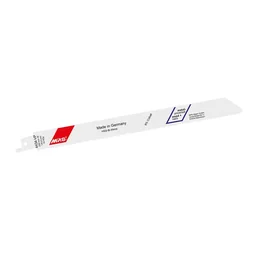
The bi-metal reciprocating saw blade with a tooth count of 10-14 TPI and a tooth pitch of 1,8-2,5 mm is an all-rounder for thicker metals. It is ideal for pipes, profiles and solid material several millimetres thick.
The coarser teeth improve chip removal, so the saw blade is less likely to clog. You achieve a higher cutting speed, although this comes at the cost of a slightly rougher cut edge. Perfect for demolition, dismantling or rough work.
: For precise cuts in thin material
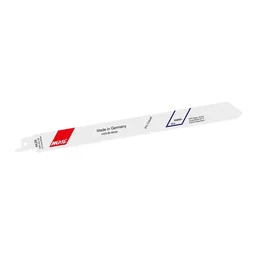
With a fine tooth count of 18 TPI and a tooth pitch of just 1,4 mm, this blade is the specialist for thin sheet metal and precision work. It cuts materials up to around 2-3 mm thick particularly cleanly and with minimal burrs.
The advantage is the smooth cut edge. Further work such as deburring is often reduced. This blade is the first choice when accuracy and a clean finish matter, for example in model making or when working on car body panels.
Practical comparison of the bi-metal blades
What are the specific differences in use? Imagine that you need to dismantle an old bicycle.
For the thick steel tubing of the frame, the is the better choice. Its robust teeth attack the material aggressively and remove chips efficiently. You get through the material faster.
If you then need to cut through a thin aluminium sheet panel, the shows its strengths. It does not “tear” the soft metal but cuts through it cleanly. The risk of the sheet becoming distorted or frayed is significantly lower.
Tip: Combine both blade types. Use the coarse blade for fast dismantling and the fine blade for dimensionally accurate cuts. This leaves you optimally equipped for any metalworking project.
Soldering instead of welding
Not every metal joint needs to be welded. Soldering is a clean and less laborious alternative for many applications, especially in electronics and with thin sheet metal.
When soft soldering, you join metals with a tin alloy that melts at lower temperatures than the base material. You need a soldering iron to heat the solder and the joint.
The wattage of a soldering iron determines how quickly it reaches its operating temperature and how well it can maintain that temperature under load. 15-25 watts are sufficient for small solder joints. For larger surfaces or thick cables, you need more power in reserve.
Soldering Irons Compared
There is a wide range of soldering irons available. We are focusing on a model that offers a good balance of performance and ease of use.
: The versatile all-rounder
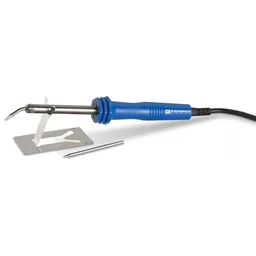
The 40Watt ECO soldering iron provides a solid performance base for most hobby and DIY projects. Its 40 watts ensure a fast heat-up time and enough power to handle more demanding solder joints.
The great advantage of this set is the selection of tips included. With the standard tip and two additional tips with a diameter of 4,9 mm, you can work on both delicate electronic components and heavier cable connections. This flexibility makes it a true workhorse.
Important: Soldering irons become extremely hot! Always use a stable stand. Never touch the front third of the iron. Allow the device to cool completely after use before putting it away.
Metalworking Buying Guide
Choose your tool based on the specific task. Ask yourself these questions:
- What material and thickness will you mainly be working with? For thick metal: coarse teeth (low TPI). For thin sheet metal: fine teeth (high TPI).
- How important is cut quality? A robust all-rounder is sufficient for rough demolition work. For precise cuts, invest in a fine-tooth quality blade.
- Are you soldering electronics or larger connections? A 25W soldering iron is sufficient for circuit boards. For cables and sheet metal, choose 40 watts or more.
- How often will you use the tool? Occasional users can manage with entry-level sets. If you use the tool regularly, investing in durable, high-quality products is worthwhile.
Always remember the accessories. When sawing, you may need cutting oil. When soldering, a holder, desoldering braid and cleaning sponge are essential.
Safety First
Metalworking is not without risks. Always protect yourself appropriately.
- Wear safety glasses to protect yourself from flying chips and sparks.
- For noisy tasks such as sawing with a reciprocating saw, hearing protection is recommended.
- Work gloves protect against sharp edges and heat, but be careful: with rotating machinery, they can pose a hazard.
- Make sure your work area is well lit and free of trip hazards.
- Use the correct protective clothing for each tool and ensure that the workpiece is securely clamped.
With the right tool from our comparison and a careful approach, nothing stands in the way of your metalworking projects. Also browse our extensive range of metalworking products and discover more professional tools for your workshop.
The highest-rated metalworking products from our range compared directly:
| Model | Customer rating | Availability |
|---|---|---|
| Bi-metal reciprocating saw blade, milled and side-set, GL 230/VL 210 mm, ZT 1,8-2,5mm/10-14TPI, pack of 5 🏆 Test winner | ★ 5,0 (11) | In stock |
| Bi-metal reciprocating saw blade, milled and side-set, GL 230/VL 210mm, ZT 1,4 mm/18TPI, pack of 5 | ★ 4,9 (9) | In stock |
| Bi-metal jigsaw blade, milled and wavy-set, GL 130/ VL 110 mm, ZT 2,0 mm/ 12TPI, pack of 5 | ★ 5,0 (2) | Currently unavailable |
| 1040A Top Line soldering gun soldering torch - 1750 degrees - 190g - automatic ignition | – | Currently unavailable |
| 15W soldering iron | – | Currently unavailable |
Frequently Asked Questions
- Which reciprocating saw blade do I need for metal?
- For metal, bi-metal saw blades with special teeth are essential. The key factor is the number of teeth per inch (TPI). For thin sheet metal (up to 2 mm), choose 18 TPI or more for clean cuts. For thicker material (from 3 mm), 10-14 TPI is more suitable because it removes chips more effectively and is less likely to clog.
- What is the difference between milled and wavy-set teeth?
- Milled and side-set teeth are more precise and produce a smoother cut edge, making them ideal for clean, near-finished results. Wavy-set teeth are more robust and less likely to clog when cutting softer metals or mixed materials, so they are well suited to demolition work. The choice depends on whether you prioritize cut quality or speed.
- How many watts should a soldering iron have for electronics?
- For delicate electronics work on circuit boards, 15-25 watts is often sufficient. If you are working with thicker cables or larger solder joints, 40 watts or more is recommended. Stable temperature control is crucial. An iron such as PRODUCT_108145 offers the flexibility needed for different tasks with 40 watts and interchangeable tips.
- Can I use a regular drill bit for metal?
- No, for metal you need special metal drill bits made from high-speed steel (HSS) or carbide. They are harder and have a special point angle. Always use cutting oil to reduce heat, make drilling easier and significantly extend the drill bit's service life.
- How do I maintain my metalworking tools?
- Remove metal chips and dirt from your tools after every use. Remove corrosion immediately. Saws and drill bits should be stored in a dry, protected place. Apply a light corrosion inhibitor before long-term storage. Have blunt tools professionally sharpened or replace them to ensure clean results and your safety.