
In brief: The best sheet metal brake for you depends on your main requirements. For versatile DIY use, compact models with working widths of up to 630 mm are often ideal. Professional applications involving thicker sheet metal require reinforced bending beams and a wider working width. A quick-release mechanism can speed up your work considerably. Our comparison highlights the strengths of each design.
A good sheet metal brake is the centrepiece of a well-equipped workshop for metalworking. It transforms flat sheet metal into precisely shaped parts, whether for enclosures, brackets or creative projects. However, there is a wide range of models available. Our 2026 test and comparison helps you find the machine that perfectly matches your requirements.
We focus on the key differences in design, features and performance. You will learn what to look for when choosing a model – from working width to ease of use. This helps you make an informed decision without getting lost in technical details.
Contents
What is a sheet metal brake and how does it work?
A sheet metal brake is a stationary or portable machine for bending sheet metal. It essentially consists of two main components: a fixed bending beam attached to the table and a movable bending beam that you raise using a lever.
The sheet metal is placed between these two beams. When you operate the lever, the movable beam presses the projecting sheet metal upwards, forming a precise angle. The accuracy of the angle is controlled by stops or a degree scale.
The different drive mechanisms
You will mainly find two designs. The classic sheet metal brake uses a simple lever mechanism. It is well suited to medium sheet thicknesses and gives you a direct feel for the material.
The eccentric bending mechanism uses a lever and an eccentric. This mechanism transfers the force of the lever more efficiently and can often generate higher bending forces with less effort. This is particularly advantageous when working with thicker sheet metal.
Note: The terms “sheet metal brake” and “bending unit” are often used interchangeably. A “unit” is usually a compact device that you mount on a sturdy workbench. A “brake” can be a complete frame with its own stand.
The most important buying criteria at a glance
Before choosing a model, you should clearly define your needs. These questions will help you.
What working width do I need?
The working width determines how wide the sheets you can bend may be. It ranges from compact 630 mm models to over 1300 mm. Measure the maximum width of the parts you plan to make regularly and choose a model with a small margin.
For many DIY projects and smaller repairs, a width of 630 mm to 1000 mm is sufficient. Professional users who bend large enclosures or panels should choose widths of 1300 mm or more.
Do I need a reinforced bending beam?
A reinforced bending beam has a more robust design. It flexes less under load and ensures a more even bend across the entire working width. This is crucial for precise results, especially when working with thicker or harder sheet metal.
A standard beam is often sufficient for occasional work with thin sheet metal. If you plan to work regularly or bend steel sheet, reinforcement is a worthwhile investment in the quality of your work.
Quick-release or standard?
A quick-release mechanism allows you to quickly release and re-engage the movable bending beam. This is a major convenience benefit when you frequently need to reposition the sheet metal or carry out several bending operations in succession.
With a standard fastener, you often have to loosen and retighten a screw. This takes time. The quick-release mechanism noticeably speeds up your workflow. The product
is an example of a unit with this practical feature.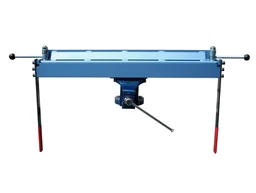
Tip: Before buying, check whether the sheet metal brake can be mounted securely and stably on your existing workbench. An unstable surface compromises precision and your safety. Heavy machines require an especially robust table.
Model comparison: strengths and applications
Not every sheet metal brake is designed for every task. Our comparison shows which models are particularly well suited to different requirements.

The highest-rated sheet metal brakes from our range compared directly:
| Model | Customer rating | Availability |
|---|---|---|
| AKE 1000 sheet metal bending attachment for universal use | – | Currently unavailable |
| AKE 1000 sheet metal bending attachment with reinforced inner bending beam | – | Currently unavailable |
| AKE 630 sheet metal bending attachment with quick-release mechanism | – | Currently unavailable |
| Sheet metal brake with bending beam, angle scale and sheet metal shear | – | Currently unavailable |
| Sheet metal brake with reinforced bending beam and angle scale | – | Currently unavailable |
Compact and versatile: the all-rounders
Compact models with a medium working width are ideal for versatile home workshops or small metalworking projects. They are affordable, space-saving and handle most common tasks.
The model with a 630 mm working width and quick-release mechanism falls into this category. It is ready for use quickly and perfect for anyone who values an efficient workflow.
Robust and precise: for professional use
When precision and long-term durability are the priorities, models with reinforced components come into their own. They are the first choice for workshops that regularly carry out high-quality bending work.
The product
combines a reinforced bending beam with a precise angle scale. This combination delivers repeatable angles even when working with demanding materials and is a reliable tool for experienced users.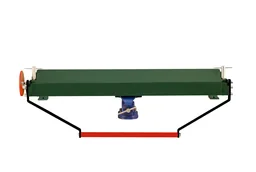
Maximum power and width: the professional solution
For large sheets and maximum bending force, eccentric models with a wide working width are the right choice. They are the powerhouses among sheet metal brakes.
The eccentric sheet metal bending attachment
with a 1300 mm working width and integrated sheet metal shear is such a professional machine. The integrated shear makes it a complete workstation for cutting and bending large sheets.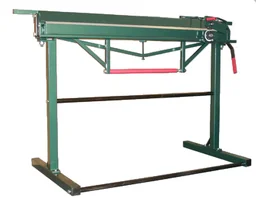
Warning: Never exceed the maximum sheet thickness specified by the manufacturer. This can cause components to break, the bending beam to jam or the lever to suddenly and uncontrollably spring loose. These situations are dangerous and can result in serious injury.
Safety when working with a sheet metal brake
Safety is the top priority. Metal edges are sharp, and levers under tension can spring back unexpectedly.
Essential protective equipment
Always wear sturdy work gloves made of leather or puncture-resistant material. They protect your hands from sharp edges on the sheet metal. Safety goggles are also essential, especially when cutting or deburring.
Sturdy steel-toe footwear and close-fitting workwear prevent you from getting caught on the machine. Remember: safety is not an annoying obligation but the foundation for successful work.
Safe working practices
Make sure the machine is stable and level. Always keep your hands outside the direct clamping area between the bending beams. Use suitable auxiliary tools such as gripping pliers when working with small parts.
Never leave the lever unattended in the raised position. Always lower it fully after the bending process. This helps prevent accidental pinching.
Care and maintenance for a long service life
A well-maintained sheet metal brake can last a lifetime. With little effort, you can preserve its precision and safe operation.
Regular cleaning and lubrication
Remove metal shavings and dust after every job. The sliding surfaces of the bending beam and the lever mechanism in particular must be kept clean. A soft brush and lint-free cloth are the best tools for this.
Lubricate all moving parts and joints regularly with suitable grease or oil. Use a product designed for metal-on-metal applications that does not quickly become gummy. This ensures smooth operation with less effort.
Inspection and adjustment
Check regularly that all screws and fasteners are tight. Vibrations can loosen them. Check that the angle scale is set to zero. If the stop has moved, readjust it according to the manufacturer's instructions.
Store your sheet metal brake in a dry place. Direct moisture promotes rust. A thin layer of protective oil on bare metal surfaces helps protect against corrosion in damp workshops.
Conclusion and buying recommendation
Choosing the right sheet metal brake is an investment in the quality of your metalworking. A well-designed model not only makes the work easier but also more precise and safer.
For the ambitious DIY enthusiast who wants to work efficiently, a compact attachment with a quick-release mechanism such as is an excellent choice. It offers good value for money and plenty of convenience in a small space.
The demanding DIYer or small business that values robust precision will find a reliable partner in a model with a reinforced bending beam such as . It provides the basis for professional results.
For large sheets, high forces and daily workshop use, a professional solution such as the eccentric sheet metal bending attachment is hard to beat. The combination of power, width and integrated shear makes it a complete workstation.
Analyse your typical projects, measure the sheet sizes you need and then choose the model that best meets your requirements. With the right sheet metal brake, you can explore all the possibilities of creative and precise metalworking.
Frequently Asked Questions
- What is the most important difference between a basic and a professional sheet metal brake?
- The main difference lies in the design and load capacity. Professional models often feature reinforced bending beams, more precise degree scales and are designed for continuous, heavy-duty use. They bend thicker sheet metal more accurately and withstand greater forces, while simpler models are intended for thinner materials and occasional use.
- What material thicknesses is a sheet metal brake suitable for?
- The maximum material thickness depends on the model. Compact sheet metal brakes for DIY use typically handle sheet metal up to around 1.5 mm thick. Professional machines with reinforced components can handle considerably more. Always check the manufacturer's technical specifications for the maximum sheet thickness to avoid overloading the tool.
- Do I need a sheet metal brake with an integrated sheet metal shear?
- No, an integrated shear is a convenience feature. It saves time and space because you can cut the sheet metal to size and then bend it directly. However, if you already own a good sheet metal shear or buy pre-cut sheets, a dedicated bending machine is often the more cost-effective choice.
- How important is a degree scale on a sheet metal brake?
- It is very important for precise results. An easy-to-read degree scale, ideally with a vernier, enables repeatable bending angles. Without a scale, you have to laboriously check the angle with a protractor. A scale may be sufficient for simple, rough work, but it is essential for precise folds and recurring tasks.
- Can I use a sheet metal brake to work with materials other than steel?
- Yes, generally speaking. Sheet metal brakes are also suitable for softer metals such as aluminium, brass or copper. Pay attention to the maximum material thickness, as these metals behave differently. For plastics or wood, special bending devices are usually more suitable because the pressure is distributed differently.
You might also be interested in
- Choosing a Sheet Metal Brake: Tips for the Perfect Purchase
- Sheet Metal Shears Test & Comparison 2026
- Wood Lathe Test & Comparison 2026: The Best Models Reviewed
- Band Saw Test & Comparison 2026: The Best Models Put to the Test
- Diagonal Cutter Test & Comparison 2026
- Grinding Machine Test & Comparison 2026