
In brief: Use tomato supports as soon as your tomato plant reaches a height of 20 to 30 cm. This is the ideal time because the stem is strong enough, while the root system is not yet too extensive. This helps prevent root damage and gives the plant stable support from the start for strong growth.
Every gardener knows the sight: young tomato plants stretching vigorously towards the sun. But without the right support, they can quickly buckle under the weight of their own fruit. The question is not whether to provide support, but when. The right timing affects plant health, stability and ultimately the yield of your harvest. Acting too early can restrict growth, while acting too late risks irreparable damage to roots and shoots.
The right helper ensures a secure footing from the start. The Tomato supports, 2-piece set is designed precisely for this task. The robust steel anchors give your plants the support they need without disturbing the delicate root system. Thanks to their clever design, they grow with the plant and provide reliable support throughout the season. This allows your tomato plant to devote all its energy to producing juicy fruit.
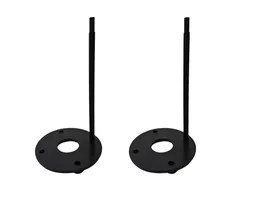
Early support is the foundation for a long and healthy plant life. A tomato plant supported from the beginning invests its energy in fruit, not in fighting gravity.
Why is the right time to support tomato plants so important?
Timing the placement of tomato supports is more than a formality. It is a strategic decision that lays the foundation for a successful season. If you wait too long, you risk serious problems that can be difficult to correct.
One major problem with acting late is root damage. A young tomato plant initially has a compact root system. As it grows, the roots spread through the soil. If you then try to drive an anchor into the ground, you will inevitably injure these fine roots. The plant suffers stress, its water and nutrient uptake is disrupted, and it becomes more vulnerable to disease. You force the plant to spend energy repairing its roots instead of growing and producing fruit.
Another risk is the main stem bending or breaking. Without support, the growing stem tends to lean under its own weight or in strong winds. If you try to tie an already curved shoot straight to a support, you create tension in the plant tissue. In the worst case, the shoot snaps and your plant loses its growing tip. The result is a major setback in growth.
How can you tell when it is the right time to use tomato supports?
Finding the perfect time is easy when you pay attention to the right signals from your plant. Do not rely on fixed calendar dates; instead, observe the growth of your tomatoes. Three key indicators will help you decide.
Plant size as an indicator
The height of the tomato plant is the most obvious and reliable sign. The ideal time to use a tomato support is when the plant has reached a height of about 20 to 30 cm. At this stage, the main stem is already strong enough to be tied up, but the plant is still flexible. At the same time, the root system is still manageable, allowing you to position the support without causing significant damage.
Development of the root system
You cannot see the root system directly, but you can estimate its development. Immediately after planting in a bed or larger pot, the plant needs several days to weeks to form new roots and become established. Act within this window. Once the plant shows a noticeable growth spurt, this indicates that the roots are already actively penetrating the soil. This is the last good opportunity to install the support.
Pro tip
Place the tomato support in the bed at the same time as you plant the young plant. This guarantees that you will not disturb root growth, and the plant can orient itself around the support from the beginning. This is the gentlest method for stress-free establishment.
First flower buds and fruit formation
By the time you spot the first small, yellow flower buds at the latest, the support should already be in place. Flower formation is a sign that the plant is entering its reproductive phase and will soon set fruit. This fruit will quickly gain weight and place strain on the stem. Without stable support, the risk of the stem bending or breaking is particularly high at this stage. Act before the first fruit reaches the size of a pea.
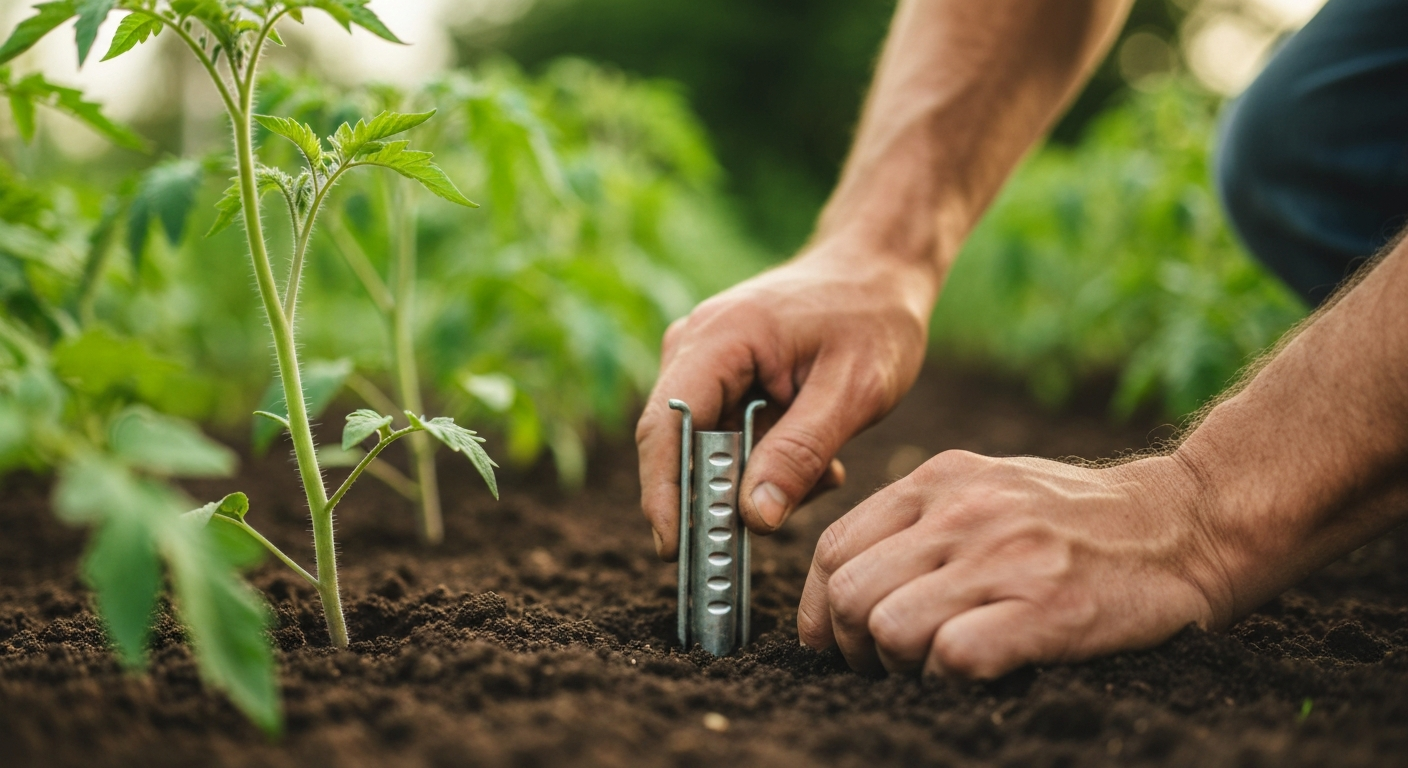
How do you use a tomato support correctly? A step-by-step guide
Correctly positioning the support is just as important as choosing the right time. With a few simple steps, you can provide stable, secure support throughout the gardening season.
- Preparation: Choose a sturdy tomato support. Loosen the soil slightly at the planned location to make insertion easier.
- Positioning: Place the support about 5 to 10 cm away from the main stem of the tomato plant. This distance protects the main roots located directly around the stem from injury. Position the support on the side most exposed to the wind to give the plant additional stability.
- Insertion: Push the support vertically into the soil with even pressure to a depth of at least 20 to 30 cm. The taller the tomato variety grows, the deeper the support should be inserted. It must be firmly anchored in the soil and should not wobble when you shake it.
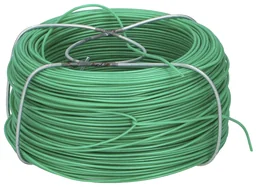
- First tie: Tie the main stem of the tomato plant loosely to the support. Use soft, elastic material such as the binding wire for flowers and plants or special plant clips. The loop should be large enough for the stem to continue increasing in thickness without being constricted. A figure-eight loop, with the tie crossed between the stem and support, prevents friction.
Important note
Never use thin wire or hard plastic cord for tying plants. When the plant moves in the wind or increases in thickness, these materials can cut into the delicate stem. Such injuries provide entry points for fungal diseases and can disrupt the plant's water-conducting vessels.
What alternatives are there to tomato supports?
Although tomato anchors are an excellent and flexible solution, other garden and plant accessories may be suitable depending on your garden and tomato variety. Traditional wooden or bamboo stakes are widely used, but they can become rotten over the years. Metal spiral stakes offer the advantage of allowing you to guide the plant easily around the stake, reducing the need for tying.
For larger beds or several plants in a row, trellises or homemade frames made from wire and posts are suitable. These allow you to train several stems of one plant. Trellis support kits are another good and flexible option. The 3x set of 3 plant supports can be arranged flexibly and effectively supports not only tomatoes but also other climbing plants such as cucumbers and beans.
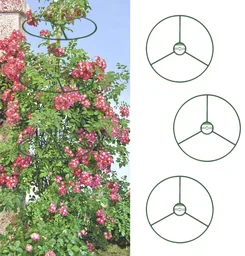
Tomato cages completely surround the plant. They are particularly suitable for bush varieties because they also support the side shoots. The disadvantage is that harvesting and removing side shoots inside the cage can be somewhat more awkward.

Seasonal care: What happens after setting up tomato supports?
Setting up the support is not the end of the job. A good support provides the basis for further care measures that are essential for a plentiful harvest. Stability gives you better access to the plant and helps keep it healthy.
Regularly tying and training the plant
Your tomato plant grows quickly, often several centimetres per day. Check its growth at least once a week and attach the main stem to the support again every 20 to 30 centimetres. This ensures that the plant is supported throughout and does not bend or break under the weight of new leaves and fruit trusses.
Additional advice
During your regular checks, also inspect the existing ties. Loosen loops that have become too tight to prevent them from cutting into the stem. The stem must be able to thicken freely. Healthy stem growth is essential for transporting nutrients.
Removing side shoots for stronger growth and better ventilation
Stable support makes removing side shoots much easier. Simply pinch out the small shoots that grow in the leaf axils with your fingers. These shoots would only take energy away from the plant that could be better directed into the main fruit trusses. A well-pruned and supported plant also has better air circulation. The leaves dry more quickly after rain, which drastically reduces the risk of fungal diseases such as blight. Effective plant protection therefore begins with a good structure.
Optimising fertilisation and watering
An upright-growing plant can be watered more precisely and efficiently. You can direct the water straight to the root area without wetting the leaves. This also helps prevent disease. Applying plant and flower fertiliser is easier too. The soil around the stem is accessible, so you can apply liquid fertiliser or granules without difficulty.
The quality of the harvest begins not with the fruit, but with the roots and stem. A stable framework ensures optimum ventilation and nutrient supply, which is reflected directly in the flavour of the tomatoes.
By choosing the right time to set up your tomato anchor and supporting the plant throughout the season, you create the ideal conditions for healthy growth and a plentiful, flavoursome harvest. Your efforts will be rewarded with every juicy tomato.
Frequently Asked Questions
- How deep should a tomato anchor be pushed into the soil?
- A tomato anchor should be at least 20 to 30 centimetres deep in the soil to provide sufficient stability. In loose soil or with very tall-growing varieties, it is better to push it even deeper. The anchor must withstand the weight of a fully laden plant and strong winds.
- Can I set up tomato supports later?
- Yes, this is possible, but it is riskier. If you add a support later, you must be very careful not to damage the well-developed root system. Injuring the roots can weaken the plant and make it more susceptible to disease. Acting early is always the better choice.
- What is the ideal distance between a tomato plant and its anchor?
- Keep a distance of around 5 to 10 centimetres between the main stem of the tomato plant and the anchor. This distance prevents you from damaging the roots directly when inserting it. At the same time, it is close enough to provide effective support without constricting the stem.
- Is one tomato anchor enough per plant?
- For most cordon tomatoes grown with a single stem, one sturdy tomato anchor per plant is sufficient. For heavily branched bush tomatoes or when you leave several stems on one plant, two anchors or a wider trellis may be necessary to support all the heavy fruit trusses.
- What should I do if the main stem of my tomato plant breaks?
- If the main stem breaks above a strong side shoot, there is no need to panic. Remove the broken section cleanly and train this side shoot upwards along the support as the new main stem. The plant will recover and continue to produce fruit.
You may also be interested in
- Want to buy tomato anchors? Your guide to sturdy tomato plants
- My tomato plants are breaking! How to support them properly and safely
- Tomato plants through the seasons: growing and care
- How to plant tomatoes properly for a plentiful harvest
- How to set an anchor correctly: Step-by-step installation guide
- How to set ground anchors correctly: Your guide to stable lawn edges