
In brief: Choose a play lawn for a robust, hard-wearing lawn where children and pets can play. It is easy to maintain and regenerates quickly. Choose an ornamental lawn if you want a purely decorative, deep-green and dense carpet of grass that will be used lightly and requires intensive care.
A lush, green lawn is the pride of every gardener. But before you reach for a packet of seed, you face a fundamental decision: should you choose a robust play lawn for the whole family or an immaculate ornamental lawn reminiscent of English parks? Choosing the right grass seed will determine whether you enjoy or regret your lawn in the years to come.
Both lawn types have their place, but they make very different demands in terms of use and maintenance. We explain the key differences and help you find the perfect lawn variety for your needs.
- What is the key difference between a play lawn and an ornamental lawn?
- How do I know which type of lawn is right for my garden?
- The right approach: How to lay play and ornamental lawns correctly
- Detailed care: How to keep your lawn looking good all year round
- Special cases and alternatives: What if neither a play nor an ornamental lawn is suitable?
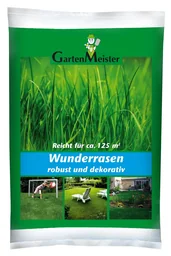
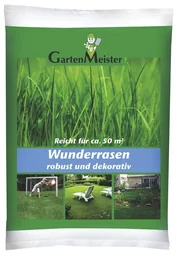
For most gardens where people live, play and relax, a hard-wearing, fast-regenerating mixture is the best choice. The grass seed "Wunder Rasen", 2,5 kg () is an all-rounder of this kind. It combines durability with a dense, attractive sward, making it ideal for a typical family garden. For smaller areas or overseeding, it is also available in a 1-kg pack ().
What is the key difference between a play lawn and an ornamental lawn?
The fundamental difference lies in the composition of the grass seed mixture. This determines all its other properties, including durability, appearance and maintenance requirements.
The grass mixture: The heart of every lawn
A lawn never consists of just one type of grass. The art lies in choosing the right mixture, known as a standard seed mixture (RSM).
- Play lawn: Robust and fast-regenerating grasses dominate here. The main component is often perennial ryegrass (Lolium perenne), which is extremely hard-wearing and grows quickly. It is complemented by Kentucky bluegrass (Poa pratensis), which creates a dense sward and fills gaps, as well as red fescue (Festuca rubra), which also copes with drier conditions. The result is a lawn that can withstand a lot.
- Ornamental lawn: Fine, slow-growing grasses are used to create the perfect “English” lawn. Varieties such as fine-leaved red fescue and Chewings fescue form extremely dense, carpet-like surfaces with a deep-green colour. However, these grasses are sensitive and are not designed for heavy use.
Choosing grass varieties is like putting together a team. With a play lawn, you need robust athletes; with an ornamental lawn, elegant dancers. Each grass has a specific role in the final result.
Durability in direct comparison
This is where the biggest practical difference becomes clear. A sports and play lawn is made for outdoor life. Whether it is a children's birthday party, a game of football or playing with the dog, it forgives a lot. Strong roots and rapid growth ensure that gaps and bare patches quickly fill in again.
An ornamental lawn, on the other hand, is purely decorative. Even regular foot traffic leaves marks. It is intended for gardens where appearance is the main priority, such as front gardens or as a formal green space around a house.
Maintenance requirements and demands
The durability of a play lawn makes it easier to maintain. It even forgives the occasional mowing mistake and is less susceptible to disease. However, because it is used heavily, it needs regular nutrients in the form of fertiliser to stay strong.
An ornamental lawn is a diva. It demands a perfect cut, regular watering and precisely balanced feeding. If you neglect it, it quickly responds with moss, weeds and yellow patches. Its maintenance requirements are significantly higher.
How do I know which type of lawn is right for my garden?
Before making your decision, ask yourself a few honest questions about how you use your garden and how much time you have available. Your answers will lead you directly to the right lawn mixture.
Additional advice
Answer these questions to help make your choice:
- Use: Will the lawn be a play area for children or pets? Do you often host barbecues? Or will it serve purely as an attractive frame for your flower beds?
- Time for maintenance: How much time would you like to spend each week mowing, fertilising and watering? Are you prepared to use a robotic lawnmower and follow precise fertilising schedules?
- Location: Is the area in full sun or partial shade? Is the soil more sandy or clay-rich?
The conclusion is simple: the more important practical use is, the clearer the choice of a play lawn becomes. If immaculate appearance is your top priority and you have the time and willingness for intensive maintenance, an ornamental lawn is an option.
For the vast majority of home gardens where people live, play and relax, a high-quality play lawn is the more practical and less stressful choice. It offers an excellent compromise between attractive appearance and high functionality.

The Right Installation: How to Properly Lay a Play Lawn and Ornamental Lawn
Careful soil preparation is half the job when it comes to a dense, healthy lawn, regardless of the type you choose. This is not an area where you should compromise.
Soil Preparation as the Foundation
Start by completely clearing the area of old grass, weeds, stones and roots. Dig over the soil to spade depth and work it through with a rotary tiller or cultivator to loosen it. For heavy, clay soils, work in sand to improve drainage. For light, sandy soils, compost helps retain water and nutrients more effectively.
A soil test will tell you the pH value. If it is below 5.5, you should raise it using Lawn Lime & Garden Lime. Then level the area with a rake. A lawn roller helps compact the soil and create a smooth surface for sowing.
Sowing – Technique and Timing
The best time to sow is in spring (April/May) or early autumn (September). Soil temperatures are ideal for germination at these times. Spread the grass seed evenly. A broadcast spreader is ideal for this and prevents bare patches or areas that are too dense.
Lightly rake the seed into the top layer of soil (approx. 1 cm), then roll the area again. Good contact with the soil is essential for the seed to germinate.
Expert tip
Sow half the seed lengthways and the other half crossways. This cross-sowing technique ensures particularly even distribution and produces a flawlessly dense sward later on.
The First Few Weeks Are Crucial
The most critical phase begins after sowing. The area must be kept consistently moist for the following three to four weeks. If the soil dries out completely even once, the delicate seedlings will die. Use a sprinkler with a fine nozzle for garden watering so that the seed is not washed away.
The first cut should be made when the grass blades have reached a height of approximately 8-10 cm (play lawn) or 6-8 cm (ornamental lawn). Only cut the blades back by about one third. A sharp mower blade is essential to avoid pulling the young plants out of the soil.
Detailed Lawn Care: How to Keep Your Lawn Looking Great All Year Round
The right care routine keeps your lawn healthy, dense and resilient. Play and ornamental lawns have different needs in this respect.
Mowing: The Right Height and Frequency
The cutting height has a major impact on the health of your lawn.
- Play lawn: A cutting height of 4 to 5 cm is ideal. This protects the sward from drying out and leaves the grass with enough leaf mass for photosynthesis. During the main growing season, you should mow once a week.
- Ornamental lawn: It requires a short cut of 2 to 3 cm to promote its fine texture and density. This means mowing two to three times a week during the season. A cylinder mower delivers the best results here.
Owners of robotic lawn mowers can use special seed mixtures. Robot Mower Lawn Seed for Overseeding () contains grasses that tolerate frequent, short mowing particularly well and form a dense sward.

Regular mowing is like a haircut for your lawn. It encourages the grass to grow outwards and form a dense, impenetrable sward that leaves weeds no chance.
Fertilising: Nutrients for Strong Growth
Every time you mow, nutrients are removed from the lawn. You need to replace them with targeted fertilisation. A good lawn fertiliser contains the main nutrients nitrogen (for growth), phosphorus (for the roots) and potassium (for resilience).
Due to the heavy use and rapid growth, play lawns need regular applications of fertiliser from spring to autumn. Ornamental lawns require carefully balanced fertilisation to maintain their colour and density without growing too quickly.
Important Note
Never fertilise a dry lawn and water it thoroughly after application. Otherwise, you risk scorching the grass, which can cause lasting damage.
Scarifying and Aerating
Over time, a layer of moss and old clippings known as lawn thatch forms between the grass blades. This suffocates the lawn. A scarifier scores the soil and removes this thatch. A play lawn should be scarified once or twice a year (in spring and/or autumn). With a delicate ornamental lawn, proceed more carefully.
Aerating the soil with a garden fork or aerator creates holes in the ground. This loosens compacted soil and brings oxygen to the roots. It is particularly important for heavily used play lawn areas.
Special Cases and Alternatives: What If Neither a Play nor an Ornamental Lawn Is Suitable?
Sometimes the conditions in your garden call for a specialised solution. Fortunately, there is a suitable lawn mixture for almost every challenge.
Shade lawn: Is your lawn mostly shaded by trees or buildings? Standard mixtures struggle in these conditions. Special shade lawn seed contains grasses such as supine bluegrass (Poa supina), which can cope with less light while still forming a dense sward.
Dry lawn/Sunny lawn: For fully sunny areas that dry out quickly in summer, mixtures containing deep-rooting grasses are suitable. Tall fescue (Festuca arundinacea) can draw water from deeper layers of soil and stays green for longer, even in hot weather.
Sports lawn: This is the next step up from a play lawn. It is designed for extreme use, such as on sports pitches, and contains an even higher proportion of perennial ryegrass. For a private garden, it is usually excessive unless you have your own kickabout area.
Ultimately, choosing the right lawn depends on an honest assessment of your needs. For most gardens where everyday life takes place, a high-quality, hard-wearing play lawn or a universal mixture is the best choice. It combines an attractive appearance with the resilience needed for daily use. This turns your lawn into a green oasis to enjoy rather than a constant source of work.
Frequently Asked Questions
- Can I mix play lawn and ornamental lawn?
- Mixing them is not recommended. The hard-wearing grasses in play lawn will crowd out the fine ornamental lawn varieties, resulting in an uneven appearance. Choose one type to ensure a consistent lawn.
- How often do I need to water a new play lawn?
- For the first 3 to 4 weeks after sowing, you must keep the soil consistently moist. Gentle daily watering is essential to help the seeds germinate and prevent the young grass blades from drying out. Avoid waterlogging.
- Is ornamental lawn suitable for pets?
- No, ornamental lawn is unsuitable for pets. The fine grasses are not hard-wearing and are quickly damaged by dogs running around, digging or urinating. For gardens with pets, hard-wearing play lawn is the better choice.
- When is the best time to sow grass seed?
- The ideal times are spring, from April to May, and early autumn, in September. The soil is warm enough for germination, while extreme summer heat and the first frost do not yet pose a threat to the young grass.
- My lawn has bare patches. Do I need to lay a completely new lawn?
- No, usually not. You can repair bare patches with an overseeding mix. Loosen the soil, remove any weeds, sow the seeds and keep the area well watered until the gap has closed.
You might also be interested in
- Buying grass seed: The guide to a thick, green lawn
- Seeded lawn or turf? The ultimate decision guide
- Grass seed germination time: The facts for your perfect lawn
- Grass seed care: What to do in the first few weeks after sowing
- Sowing grass seed: The right amount is crucial
- Sowing grass seed: Your path to the perfect lawn